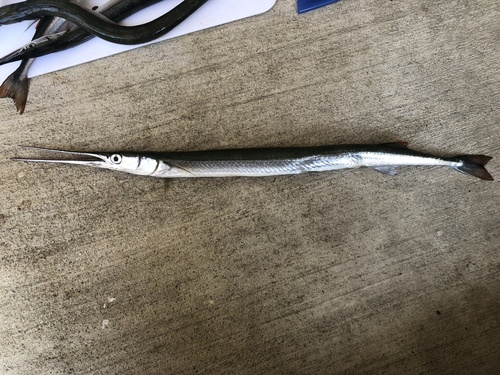
California Needlefish
Strongylura exilis
With its shimmering silver body and needle-like beak, the California Needlefish is a master of the coastal surface. This slender predator is a common and captivating sight for those exploring the bays and piers of the Pacific coast.
Quick Identification
Size
Typically 50–75 cm (20–30 inches) in length, with large individuals reaching 1 meter (39 inches).
Colors
Silvery iridescent sides and belly with a distinct bluish-green or olive-green back; may feature a dark horizontal stripe.
Key Features
- Extremely elongated, beak-like jaws
- Needle-sharp teeth visible in the jaw
- Very slender, cylindrical body shape
- Dorsal and anal fins set far back near the tail
When You’ll See Them
Geographic range
Where Does the California Needlefish Live?
The California Needlefish is native to the Eastern Pacific Ocean, thriving in the warm-temperate and tropical waters along the coast. Its range begins in Southern California, United States—specifically from the Santa Monica Bay southward—and extends through the Gulf of California and down the coast of Mexico. It continues along Central America and reaches as far south as the coastal waters of Peru.
Basemap © OpenStreetMap contributors
Behavior
California Needlefish are specialized surface-dwelling predators known for their sleek, arrow-like appearance. They are often seen hovering almost motionlessly just below the water's surface in bays, estuaries, and nearshore coastal waters. When they spot prey, they utilize their streamlined bodies for sudden, high-speed bursts of acceleration, snapping their long jaws sideways to snag small fish.
These fish are generally found in small groups or cruising solo. They are famous for their leaping ability; when startled or attracted by artificial lights at night, they can skip across the water's surface at high speeds. While they are not aggressive toward humans, their sharp beaks can be a hazard if they leap toward a boat or a light source. In the backyard context of a canal or coastal dock, they are fascinating to watch as they exhibit sophisticated stalking behaviors near the surface.
EverydayEarth exclusive
Camera Tips
Capturing the California Needlefish on a backyard or dock-mounted camera requires focusing on the top twelve inches of the water column. Because these fish are surface-dwellers, an underwater action camera or an AI-enabled camera should be mounted just below the waterline, facing horizontally. If you are mounting the camera to a dock piling, ensure it is positioned in an area with steady but gentle current, as needlefish often wait in these spots for baitfish to drift by.
Lighting is your biggest challenge and your best friend. During the day, the silver scales of the California Needlefish reflect sunlight beautifully, but surface glare can confuse AI motion detection. To combat this, position your camera facing away from the direct sun or use a polarizing filter on the lens to cut through the water's surface reflection. If your camera is above the water looking down, a high-angle 'bird's eye' view is better for capturing their long silhouette than a low-angle shot that may only see the glare of the ripples.
While traditional bait doesn't work for needlefish since they prefer live, moving prey, you can 'set the stage' by choosing a location near submerged structures like kelp or dock lights that naturally attract small baitfish. At night, a green or white underwater light can attract needlefish, but be aware that they are known to jump toward lights, so ensure your equipment is securely fastened and waterproof. Set your camera's shutter speed as high as possible; these fish move with lightning-fast lateral strikes that can appear as a blur on standard settings.
Similar Species
Species that look similar or are commonly confused with California Needlefish.
Pacific Needlefish
Generally larger and found in more tropical waters, with a slightly deeper body profile than the California variety.
California Halfbeak
Only the lower jaw is elongated in the halfbeak, whereas the California Needlefish has both jaws elongated into a beak.
Pacific Barracuda
Much thicker body and lacks the extremely long, needle-like beak of the Strongylura species.
Frequently Asked Questions
Record California Needlefish at your habitat
Connect a camera to start building your own species record — AI identifies every visitor automatically.