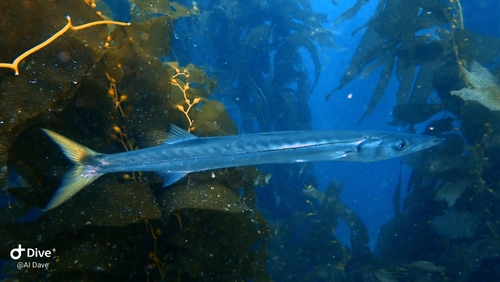
Pacific Barracuda
Sphyraena argentea
The 'Silver Streak' of the Pacific, this torpedo-shaped predator is a master of the kelp forest. Known for its incredible speed and schooling behavior, the Pacific Barracuda is a true icon of the West Coast.
Quick Identification
Size
Length up to 1.2 metres (4 feet); weight up to 6.8 kilograms (15 pounds)
Colors
Silvery sides with a bluish or grayish-green back; tail fin is often yellowish; lacks the dark bars found on tropical cousins
Key Features
- Slender, torpedo-shaped body
- Protruding lower jaw with sharp, needle-like teeth
- Two widely separated dorsal fins
- Distinctive silvery sheen without vertical bars
When You’ll See Them
Geographic range
Where Does the Pacific Barracuda Live?
The Pacific Barracuda is native to the eastern reaches of the North Pacific Ocean. Its core population density is concentrated between Cabo San Lucas in Baja California and Point Conception in Southern California, though they are frequently found as far north as Washington State during warm-water years. This species is a classic inhabitant of the California Current, following the flow of temperate and subtropical waters along the western coast of North America.
Basemap © OpenStreetMap contributors
Behavior
The Pacific Barracuda is a high-speed pursuit predator built for agility and sudden bursts of velocity. Unlike the solitary and often stationary behavior seen in the Great Barracuda of the Caribbean, the Pacific variety is much more social, frequently congregating in massive, shimmering schools. These schools move rhythmically through the water column, often circling near the surface or hovering around the edges of kelp forests to intercept migrating baitfish.
As visual hunters, they are most active during the daylight hours when they can utilize their keen eyesight. They are known for their "ram-feeding" technique, where they swim at high speeds with an open mouth to overtake prey. While their toothy grin and fast movements can be startling to divers, they are generally indifferent to humans and are not considered a threat in their native Pacific waters.
EverydayEarth exclusive
Camera Tips
To capture the Pacific Barracuda on an AI-powered camera, you will need an underwater housing or a specialized submersible camera rig. The most effective placement is near vertical structures like pier pilings or at the transition zone where a kelp forest meets open water. Position the camera 1 to 2 metres below the surface, as these fish are surface-oriented hunters. Angling the lens slightly upward can help silhouette their long, slender bodies against the sunlight, making for dramatic footage.
Lighting is your best friend when filming these silver-sided predators. They are highly reflective, so capturing them during the "golden hours" of early morning or late afternoon provides the best contrast. Avoid using heavy artificial light at night, as they are primarily diurnal and will likely be less active. A high frame rate (at least 60fps) is essential; their strikes on prey are incredibly fast, and standard frame rates often miss the moment of impact, leaving you with just a blur.
While you should never feed wildlife, you can increase your chances of a sighting by placing the camera near natural "choke points" where baitfish congregate. In a backyard dock setting, look for areas where the tide pushes small fish against a bulkhead. The barracuda will often cruise these edges looking for an easy meal. During the summer months, keep an eye on surface activity; if you see small fish jumping, that is the perfect spot to drop your camera rig to catch the barracuda in a feeding frenzy.
Similar Species
Species that look similar or are commonly confused with Pacific Barracuda.
Great Barracuda
Much larger with dark blotches on the lower sides; prefers tropical reef waters.
California Yellowtail
More robust body with a distinct horizontal yellow stripe and a deeply forked yellow tail.
White Seabass
Thicker body profile and lacks the needle-like teeth and torpedo shape of the barracuda.
Frequently Asked Questions
Record Pacific Barracuda at your habitat
Connect a camera to start building your own species record — AI identifies every visitor automatically.