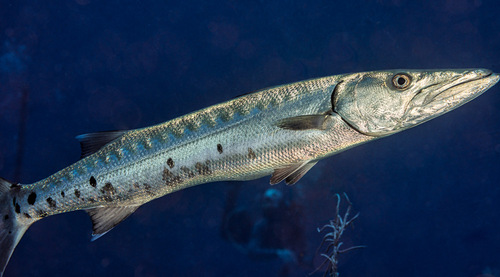
Great Barracuda
Sphyraena barracuda
The silver ghost of the reef, the Great Barracuda is a master of the ambush. With its torpedo-shaped body and razor-sharp teeth, this apex predator is as fascinating as it is formidable.
Quick Identification
Size
Length typically 60–100 cm (24–39 in), but can reach up to 200 cm (79 in); weight ranges from 2.5–9 kg (5.5–20 lb) up to 50 kg (110 lb).
Colors
Brilliant silver-gray upper body fading to a white belly; distinct dark, irregular spots on the lower flanks; dorsal fins often have a dark or greenish tint.
Key Features
- Elongated, torpedo-shaped body built for speed
- Large, powerful lower jaw that protrudes past the upper jaw
- Prominent, sharp, knife-like teeth of varying sizes
- Two widely separated dorsal fins and a deeply forked tail
When You’ll See Them
Geographic range
Where Does the Great Barracuda Live?
The Great Barracuda is a cosmopolitan resident of the world's warm oceans, found in nearly all tropical and subtropical seas with the notable exception of the Eastern Pacific. This species is a staple of the Atlantic Ocean, ranging from the Massachusetts coast down to southern Brazil and across the Caribbean Sea. In the Indo-Pacific, they thrive from the Red Sea and East Africa all the way to the Hawaiian Islands and the northern coasts of Australia, making them one of the most widely distributed large predators in the marine world.
Basemap © OpenStreetMap contributors
Behavior
The Great Barracuda is an apex predator known for its combination of extreme curiosity and explosive speed. While juveniles are often social, forming large schools in the safety of mangroves and shallow seagrass beds, adult barracudas are primarily solitary. They are visual hunters that often trail larger predators or even human divers, not out of aggression, but to scavenge prey disturbed by the larger animal's movement.
Despite their fearsome appearance and rows of visible teeth, they are generally not a threat to humans unless provoked or in murky water where a shiny object, such as jewelry, is mistaken for a shimmering baitfish. In their daily routine, they spend much of their time hovering almost motionless in the water column, using their keen eyesight to scan for movement before launching a high-speed strike that can reach nearly 35 miles per hour.
EverydayEarth exclusive
Camera Tips
Capturing the Great Barracuda on camera requires an underwater setup, ideally an action camera with high-frame-rate capabilities (at least 60fps) to slow down their lightning-fast strikes. For coastal backyard enthusiasts with docks or seawalls, a submersible camera housing mounted to a weighted tripod or a fixed piling provides the best vantage point. Ensure your camera is positioned to capture the 'blue water' background where these predators like to patrol the transition zones between shallow flats and deeper channels.
Lighting is the most critical factor for a clear shot. Because the barracuda's silver scales are highly reflective, direct noon sunlight can cause 'blown out' highlights that obscure detail. Aim for the 'golden hours' of early morning or late afternoon when the light enters the water at an angle, highlighting the dark spots on their flanks. If you are using artificial lights, use a wide-angle beam to avoid 'backscatter' (reflecting off particles in the water) and to reveal the barracuda's true colors without startling them.
One unique consideration for this species is their attraction to shiny objects. Avoid using metallic or silver-colored camera mounts or tethers, as a barracuda may strike the equipment thinking it is prey. A matte black housing is the safest choice. To attract them naturally without bait, place the camera near structure like a reef edge or a mangrove root system where baitfish congregate. Barracuda are naturally curious and will often approach a stationary camera to investigate it, providing excellent close-up opportunities.
Similar Species
Species that look similar or are commonly confused with Great Barracuda.
Frequently Asked Questions
Record Great Barracuda at your habitat
Connect a camera to start building your own species record — AI identifies every visitor automatically.