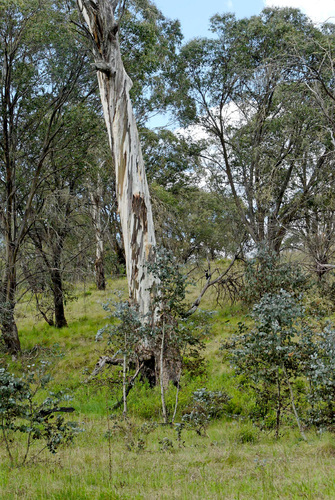
Candlebark
Eucalyptus rubida
A masterpiece of the Australian tablelands, the Candlebark is famous for its glowing white trunk that blushes deep pink in the autumn. It is a vital sanctuary for nectar-loving birds and hollow-dwelling mammals alike.
Quick Identification
Size
A medium-sized tree typically reaching 10-40 metres (33-131 feet) in height with a trunk diameter up to 1 metre (3.3 feet).
Colors
Powdery-white to creamy bark that develops distinctive patches of pink, red, or plum-orange before shedding; adult leaves are a dull greyish-green.
Key Features
- Smooth white bark that sheds in long, ribbon-like strips
- Flower buds uniquely arranged in clusters of three
- Juvenile leaves are round and blue-grey, while adult leaves are long and lance-shaped
- Bark often turns a vibrant reddish-pink during the cooler months before peeling.
When You’ll See Them
Geographic range
Where Does the Candlebark Live?
Native to the southeastern corner of Australia, the Candlebark is a defining feature of the cooler, high-altitude landscapes. Its range spans the northern tablelands of New South Wales, through the Great Dividing Range into Victoria, and across to the eastern parts of South Australia. It is also widely distributed across the state of Tasmania, particularly in drier, open forest environments.
Basemap © OpenStreetMap contributors
Behavior
The Candlebark is a fast-growing evergreen eucalyptus best known for its stunning seasonal bark transformation. Throughout most of the year, the trunk is a brilliant, waxy white, but as the seasons change, the outer layers of bark begin to take on deep pink, red, and orange tones. This color shift is the origin of its scientific name 'rubida,' which refers to its reddish hue. When the bark eventually sheds, it peels away in long, leathery ribbons that often catch and hang from the lower branches.
Beyond its visual appeal, the Candlebark plays a vital role in its ecosystem. It is a prolific producer of nectar and pollen, making it a hub of activity for native bees, butterflies, and nectar-feeding birds. As the tree matures, it naturally forms hollows which serve as essential nesting sites for various parrot species and arboreal mammals like the Sugar Glider. It is a resilient species, capable of withstanding heavy frosts and snow, which allows it to dominate the cooler tableland regions of Australia.
EverydayEarth exclusive
Camera Tips
When setting up a camera near a Candlebark, focus on the 'habitat hubs' the tree provides rather than just the trunk. Position your camera on a nearby post or a lower branch of a different tree, aiming at a major fork or a hollow in the Candlebark. These are high-traffic areas for gliders, possums, and owls. If you're interested in ground-dwelling visitors, aim the camera at the base of the trunk where the fallen bark ribbons accumulate; these piles often hide lizards and foraging echidnas.
The Candlebark's brilliant white trunk is highly reflective. To avoid overexposed images during the day, try to position the camera so the sun is behind it, or utilize the shade of neighboring foliage. At night, the smooth bark acts as a natural reflector for infrared (IR) flashes. This can be an advantage as it illuminates the entire scene, but be careful not to place the camera too close to the trunk, or the white surface will cause a 'white-out' in your night photos. A distance of 3-5 metres is usually ideal.
Consider using the time-lapse mode on your AI camera during the autumn months. By taking one photo every 24 hours, you can create a fascinating sequence of the bark changing from white to deep red and eventually peeling away. This provides a unique look at the tree's life cycle that traditional motion-triggering would miss. Additionally, since this tree flowers heavily, pointing a camera at a cluster of blossoms during the summer can capture a frantic pace of honeyeater and insect activity.
Similar Species
Species that look similar or are commonly confused with Candlebark.
Manna Gum
Shares the white bark and shedding ribbons, but its flower buds are usually in clusters of seven and its leaves are generally narrower.
Snow Gum
Found at higher altitudes, featuring more twisted trunks and bark with colorful 'scribbles' or streaks rather than a solid white-to-red transition.
Frequently Asked Questions
Record Candlebark at your habitat
Connect a camera to start building your own species record — AI identifies every visitor automatically.