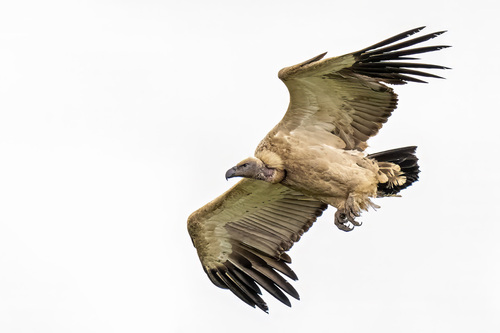
Cape Griffon
Gyps coprotheres
The Cape Griffon is southern Africa’s largest vulture, a master of the thermals that serves as nature's most efficient cleanup crew. With their massive wingspans and keen eyes, these majestic scavengers are a breathtaking sight across the southern African landscape.
Quick Identification
Size
Length: 96–115 cm (38–45 in); Wingspan: 2.26–2.6 m (7.4–8.5 ft); Weight: 7–11 kg (15–24 lbs)
Colors
Pale creamy-white body with contrasting dark brown to black flight feathers and tail; adults feature a bluish-grey unfeathered neck and yellow to amber eyes.
Key Features
- Massive wingspan with broad, finger-like primary feathers
- Pale creamy plumage with dark wing and tail edges
- Honey-colored eyes with dark pupils
- Unfeathered bluish neck skin visible at the base
- Heavy, hooked black beak designed for tearing
When You’ll See Them
Geographic range
Where Does the Cape Griffon Live?
Native to the southern tip of the African continent, the Cape Griffon is an iconic sight in the skies of Southern Africa. Its core population is concentrated within the high-altitude regions of South Africa, Lesotho, and Botswana, with smaller, more localized groups found in northern Namibia and parts of Zimbabwe. This bird thrives in open country where it can easily spot food from the air, but it remains tethered to the vertical safety of mountain ranges and Great Escarpment cliffs for its colonial breeding sites.
Basemap © OpenStreetMap contributors
Behavior
These vultures are nature's essential cleanup crew, providing a vital ecological service by consuming carrion that could otherwise spread disease. While they are often viewed with caution by farmers, they are largely harmless to healthy livestock and focus their efforts on animals that have already succumbed to natural causes or predation. Their reliance on large mammal populations means they often follow the movements of migratory herds or stay near areas with high densities of wildlife or cattle.
Interactions with humans have historically been challenging for the species. They are sensitive to disturbances at their nesting colonies and are highly vulnerable to power line collisions and accidental poisoning from veterinary drugs or baited traps intended for predators. Conservation efforts, including the establishment of 'vulture restaurants' where safe food is provided, have been instrumental in stabilizing their populations in recent years.
EverydayEarth exclusive
Camera Tips
To successfully capture a Cape Griffon on your trail camera, placement is the most critical factor. These birds are extremely wary of ground-level activity and have incredible eyesight. If you are placing a camera near a known feeding site or 'vulture restaurant,' do so well in advance to allow the birds to habituate to the device. Position the camera on a low-profile mount or directly on a rock, angled slightly upward to catch the full breadth of their 8-foot wingspan as they descend for a landing. Because they are large birds, you should set your camera’s PIR sensitivity to 'Medium'—this prevents the camera from triggering for every small bird while ensuring it catches the heavy motion of a vulture landing.
Since Cape Griffons rely on thermal air currents to gain lift, they are rarely active on the ground during the early morning or late evening. For the best results, ensure your camera is set to operate during full daylight hours. Use a fast shutter speed or 'Action' mode if your camera supports it, as the competition at a carcass can be incredibly fast-paced, with birds lunging and flapping their wings. A burst mode of 3 to 5 photos per trigger is ideal for capturing the dynamic social interactions that occur when multiple vultures are present.
If you are setting up a camera in a backyard or farm setting specifically to attract them, ensure you have a wide, open clearing. These vultures require a significant 'runway' to take off, especially after a heavy meal, and will generally avoid landing in tight, brushy areas where a predator could be lurking. Avoid using any flash at night; while they aren't active then, the glow of an IR flash can sometimes spook them if they are roosting nearby. Instead, rely on natural light to capture the stunning blue-grey tones of their neck skin and the intricate patterns of their feathers.
Similar Species
Species that look similar or are commonly confused with Cape Griffon.
Frequently Asked Questions
Record Cape Griffon at your habitat
Connect a camera to start building your own species record — AI identifies every visitor automatically.