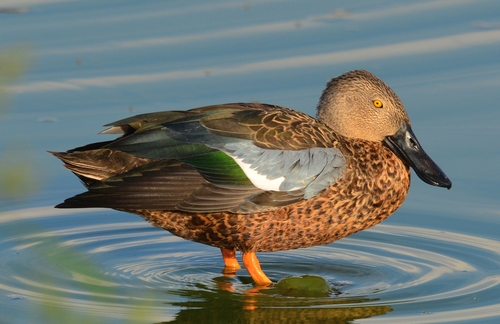
Cape Shoveler
Spatula smithii
With its unmistakable spoon-shaped bill and striking yellow eyes, the Cape Shoveler is one of Southern Africa's most specialized wetland residents. Discover how this master of the shallows uses its unique anatomy to thrive in suburban ponds and wild marshes alike.
Quick Identification
Size
Length: 51–53 cm (20–21 in); Wingspan: 80–90 cm (31–35 in); Weight: 500–850 g (1.1–1.9 lbs)
Colors
Primarily mottled dark brown and buff; males feature a greyish-blue head and striking yellow eyes; females have dark brown eyes; both sexes have a massive black bill and orange-yellow legs.
Key Features
- Exceptionally large, black shovel-shaped bill
- Striking yellow eyes in adult males
- Orange-yellow legs and feet
- Mottled brown plumage with pale blue wing patches visible in flight
When You’ll See Them
Geographic range
Where Does the Cape Shoveler Live?
Native to the southern reaches of the African continent, the Cape Shoveler is most commonly found as a resident throughout South Africa. Its range reaches north into the arid regions of Namibia and Botswana, and it occasionally appears in southern Angola, Zimbabwe, and Mozambique. While it is a permanent fixture in its core South African range, it is an opportunistic wanderer that will travel hundreds of miles to occupy seasonal floodplains in the interior of the continent.
Basemap © OpenStreetMap contributors
Behavior
The Cape Shoveler is a specialist dabbling duck known for its unique feeding method. It is often seen swimming in tight circles, a behavior called 'spinning,' which creates a mini-vortex in the water to bring small invertebrates and nutrients to the surface. While they are social birds and often congregate in pairs or small groups, they are generally quieter and more reserved than many other duck species.
In a backyard or park setting, they are relatively shy but can become habituated to human presence if their habitat remains undisturbed. They are mostly non-migratory but are known to be nomadic, moving across the Southern African landscape to find temporary wetlands and pans after seasonal rains. During the breeding season, they become more territorial, with males performing subtle head-pumping displays to defend their mates.
EverydayEarth exclusive
Camera Tips
To capture the Cape Shoveler on camera, placement is everything. These ducks are strictly tied to the water's edge, so position your camera on a low-profile stake or a stable rock just a few inches above the water line. Aim the lens parallel to the shoreline rather than out toward open water; this ensures you catch them as they forage in the shallows where their specialized bills are most active.
Given their activity peaks at dawn and dusk, ensure your camera has a high-quality infrared sensor or a fast trigger speed to handle low-light transitions. Using a 'Burst Mode' setting is highly recommended. Because shovelers often feed with a spinning motion, a single photo might result in a blurred bill, but a sequence of 3-5 shots will likely capture a sharp, clear image of their unique profile.
While you can't easily bait these ducks with grain, you can attract them by maintaining a healthy, chemical-free pond environment that supports aquatic life. If your camera supports video, set it to 20-30 second clips. The sight of a Cape Shoveler 'spinning' in a suburban pond is a fascinating behavior that makes for excellent video content. In suburban settings, they are often less skittish, so you can often place cameras closer to frequent 'haul-out' spots where they preen their feathers.
Similar Species
Species that look similar or are commonly confused with Cape Shoveler.
Frequently Asked Questions
Record Cape Shoveler at your habitat
Connect a camera to start building your own species record — AI identifies every visitor automatically.