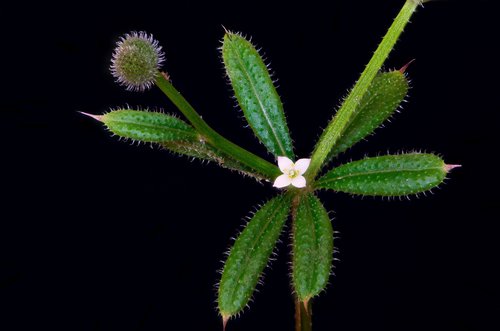
catchweed bedstraw
Galium aparine
The original inspiration for Velcro, Catchweed bedstraw is a master of mobility in the plant world. Watch it scramble over garden edges and hitchhike across your backyard using its signature hooked bristles.
Quick Identification
Size
Stems grow 1–2 meters (3–6 feet) long; flowers are approximately 2 mm (0.08 inches) in diameter.
Colors
Bright lime-green stems and leaves; tiny white flowers; green to reddish-purple seed burrs.
Key Features
- Square-shaped stems with downward-pointing hooked bristles
- Whorls of 6 to 8 narrow, lance-shaped leaves
- Sticky, 'velcro-like' texture across the entire plant
- Pairs of small, round, bristly fruits (burrs)
When You’ll See Them
Geographic range
Where Does the catchweed bedstraw Live?
Native to a vast region spanning Europe, North Africa, and temperate Asia, Catchweed bedstraw has successfully naturalized across nearly every continent. It is now ubiquitous throughout the United States and Canada, and has established strong populations in South America, Australia, and New Zealand. It thrives in almost any temperate environment where there is sufficient moisture and a bit of shade.
Basemap © OpenStreetMap contributors
Behavior
Catchweed bedstraw is a fascinating annual plant known for its 'scrambling' growth habit. Lacking a rigid woody stem, it uses thousands of microscopic, hooked bristles to latch onto neighboring plants, fences, or animal fur, effectively 'hitching a ride' to reach the sunlight. It often forms dense, tangled mats that can smother slower-growing vegetation in early spring.
This species is highly responsive to touch and physical contact; its seeds are famously distributed via 'epizoochory,' meaning they stick to the coats of passing mammals (and the socks of hikers) to be transported to new locations. In the backyard ecosystem, it provides early-season cover for small invertebrates and serves as a host plant for several species of moth larvae.
EverydayEarth exclusive
Camera Tips
To capture the unique growth of Catchweed bedstraw, use a camera with a dedicated macro mode or a high-quality time-lapse setting. Since this plant can grow several inches in a single week during the spring, setting your camera to take one frame every 30 minutes will create a stunning visual of the stems 'crawling' up a garden fence or neighboring plant. Position your camera at a low angle, roughly 12 inches from the ground, to catch the first whorls emerging from the leaf litter.
Because the plant's most interesting feature is its 'sticky' bristles, side-lighting is essential. Set your camera up so the morning or evening sun hits the plant from the side; this will catch the light on the tiny hooked hairs, making them glow against a darker background. If your AI camera has motion triggers, place it near a path where the bedstraw is overhanging. You may capture 'interaction' footage of the plant snagging onto the fur of a passing squirrel or rabbit.
For the best AI identification results, ensure the camera is close enough to resolve the individual leaves in a 'whorl' (the star-like circle of leaves). A top-down 'plan view' shot is often the most diagnostic for the software. Avoid windy days for high-resolution stills, as the long, thin stems of Catchweed bedstraw are prone to motion blur. If your camera settings allow, use a fast shutter speed (1/500s or faster) to freeze the plant's delicate structure.
Similar Species
Species that look similar or are commonly confused with catchweed bedstraw.
Frequently Asked Questions
Record catchweed bedstraw at your habitat
Connect a camera to start building your own species record — AI identifies every visitor automatically.