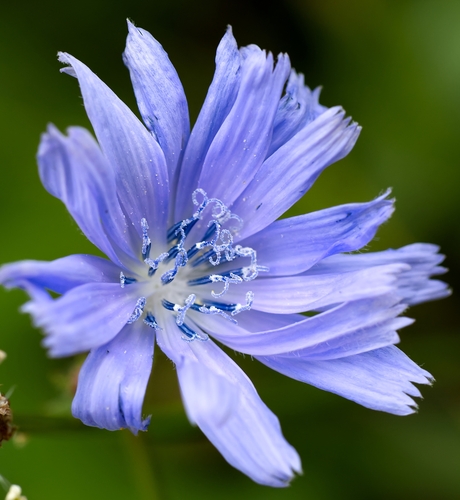
chicory
Cichorium intybus
A resilient traveler with blossoms the color of a summer sky, Chicory is more than just a roadside weed—it's a morning-blooming marvel and a vital hub for backyard pollinators.
Quick Identification
Size
Stems reach 30 to 100 cm (12 to 40 inches) in height; flowers are 2 to 4 cm (0.8 to 1.6 inches) wide.
Colors
Primarily brilliant sky blue; rarely white or pale pink. Stems are a dusty grey-green.
Key Features
- Brilliant sky-blue daisy-like blossoms
- Flowers open in the morning and close by early afternoon
- Stiff, woody, and zig-zagging stems
- Basal leaves resemble dandelions with deep lobes
When You’ll See Them
Geographic range
Where Does the chicory Live?
Originally native to the temperate regions of Europe, North Africa, and Western Asia, Chicory has successfully naturalized across nearly every continent. In North America, it is a ubiquitous sight from southern Canada through the entire continental United States and into northern Mexico. It has also established robust populations throughout Australia, New Zealand, and parts of South America, typically following human development and agricultural expansion.
Basemap © OpenStreetMap contributors
Behavior
Chicory is a fascinating perennial that operates on a strict daily schedule. Known as a 'flower clock' plant, its blossoms typically unfurl at sunrise and remain open only until the sun reaches its peak intensity in the early afternoon. On overcast days, the flowers may stay open longer, but in the heat of summer, they often shrivel by midday, leaving behind only the stiff, skeletal-looking green stems.
This species is exceptionally hardy, utilizing a deep taproot to thrive in compacted or poor-quality soil where other wildflowers might wither. While humans have historically used its roasted roots as a coffee substitute and its leaves for forage, in a backyard setting, it acts as a high-traffic hub for local ecology. It is a vital nectar source for bees and a popular perching spot for small predatory insects.
EverydayEarth exclusive
Camera Tips
To capture the best images of Chicory and the wildlife it attracts, place your camera on a ground stake or low tripod at a height of approximately 18 to 24 inches. Because the flowers are heliotropic and follow a morning schedule, position your camera facing West or Southwest to catch the morning light illuminating the blue petals without blowing out the highlights. If your camera has a time-lapse mode, this is the perfect species for it; set it to take a photo every 5 minutes from 6:00 AM to 1:00 PM to watch the 'bloom and gloom' cycle of the flowers.
Chicory is a major draw for pollinators, especially native sweat bees and honeybees. To get clear shots of these visitors, use a camera with a close-focus or macro lens capability. Since the stems are quite stiff and woody, they don't sway as much as grass, making them an ideal steady platform for high-quality insect photography. However, ensure there is no tall grass immediately behind the plant that might trigger the motion sensor on windy days, leading to 'false triggers.'
In the late summer and early autumn, don't move your camera just because the flowers have faded. American Goldfinches and other small seed-eating birds frequently land on the dried, brown stalks to pick at the seed heads. Keeping your camera active during this period will transition your gallery from 'botanical' to 'ornithological' as the plant enters its next life stage.
For the best color accuracy, avoid using infrared flash at night, as Chicory flowers will be closed anyway. Instead, rely on the natural morning light. If you are using a triggered camera, set the sensitivity to 'High' because the landing of a lightweight bee on a stiff Chicory stem may not create enough vibration or heat signature change to trigger lower sensitivity settings.
Similar Species
Species that look similar or are commonly confused with chicory.
Frequently Asked Questions
Record chicory at your habitat
Connect a camera to start building your own species record — AI identifies every visitor automatically.