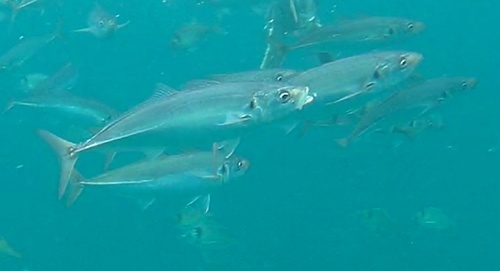
Chilean jack mackerel
Trachurus murphyi
The Chilean jack mackerel is the silver engine of the South Pacific, forming massive shimmering schools that traverse thousands of miles. A vital link in the marine food web, this streamlined predator is a marvel of migratory endurance.
Quick Identification
Size
Typically 40–50 cm (16–20 in) in length, but can grow up to 70 cm (28 in); weight ranges from 0.8 to 3 kg (1.8–6.6 lbs).
Colors
Metallic blue or blue-green on the back, transitioning to a shimmering silver-white on the belly; a distinct small black spot is visible on the edge of the operculum (gill cover).
Key Features
- Prominent row of enlarged, bony scutes along the lateral line
- Deeply forked tail with a narrow caudal peduncle
- Elongated, streamlined body built for speed
- Two dorsal fins with a small notch between them
When You’ll See Them
Geographic range
Where Does the Chilean jack mackerel Live?
Native to the South Pacific Ocean, the Chilean jack mackerel has an expansive range that stretches from the coast of South America all the way to New Zealand and Australia. Its core populations are concentrated along the coasts of Chile and Peru, following the nutrient-dense Humboldt Current, but it is also found across the 'high seas' in a vast migratory corridor known as the Jack Mackerel Belt. While it occasionally reaches as far north as the Galapagos Islands, it is primarily a species of the temperate and subtropical southern waters.
Basemap © OpenStreetMap contributors
Behavior
The Chilean jack mackerel is a highly social and pelagic species, known for forming massive, dense schools that can span several kilometers. These schools are a defensive mechanism against predators like tuna, sharks, and sea lions, but they also facilitate efficient group foraging. As a highly migratory species, they move in response to water temperature and nutrient availability, often following the nutrient-rich currents of the South Pacific.
Feeding primarily occurs through a process of ram-feeding or suction, where they target aggregations of smaller prey. While they are a deep-water species during the day, they exhibit vertical migration, rising toward the surface at night to feed. In terms of human interaction, they are one of the most significant commercial species in the world, though they are rarely encountered by casual swimmers due to their preference for open-ocean environments.
EverydayEarth exclusive
Camera Tips
Capturing the Chilean jack mackerel requires specialized underwater equipment, as these are pelagic fish that rarely venture into shallow backyard environments. If you live on a coastal property or have access to a pier, use a submersible trail camera or a GoPro in a waterproof housing. Mount the camera to a stable structure like a dock piling or a weighted tripod on the seafloor (if in shallower coastal waters) at a depth of 2 to 5 meters. Angle the lens slightly upward to catch the silver undersides of the fish reflecting the sunlight.
Because mackerel are highly attracted to light (phototaxis), nighttime is often the best time for recording. Attach a small, waterproof LED light near your camera setup to draw in the plankton that mackerel feed on. This will naturally bring the schools within the camera's field of view. Be sure to use a high frame rate (60fps or higher) to capture their rapid, darting movements without motion blur.
To increase your chances of a sighting, use a scent-based lure. A perforated PVC pipe filled with crushed sardines or fish oil (chum) suspended near the camera will create a scent trail that these predatory fish can follow from a distance. Ensure your camera is set to record long clips, as mackerel usually travel in large pulses rather than individual passes.
Check the water clarity before deployment. Mackerel are most active in nutrient-rich but clear waters. If the water is too turbid following a storm, wait for the sediment to settle to avoid getting footage of 'underwater snow' caused by backscatter from your lights. Seasonal timing is also key; look for them when coastal water temperatures are between 15°C and 20°C.
Similar Species
Species that look similar or are commonly confused with Chilean jack mackerel.
Frequently Asked Questions
Record Chilean jack mackerel at your habitat
Connect a camera to start building your own species record — AI identifies every visitor automatically.