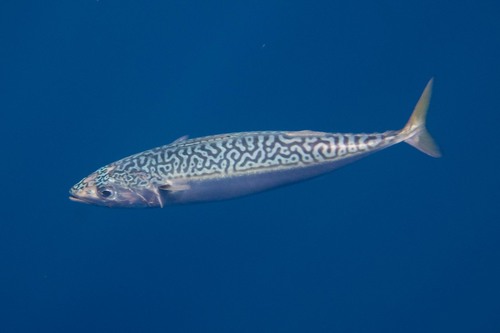
Pacific Chub Mackerel
Scomber japonicus
Meet the 'tiger of the sea,' a shimmering, high-speed traveler that brings the energy of the open ocean right to the coastline. With their striking iridescent patterns and relentless energy, Pacific Chub Mackerel are a marvel of marine synchronized swimming.
Quick Identification
Size
Typically 8-14 inches (20-35 cm) in length and weighing 1-2 lbs (0.5-0.9 kg), though they can reach up to 25 inches.
Colors
Iridescent blue-green or silvery-green back with dark, wavy lines; silvery-white belly without spots.
Key Features
- Wavy, 'tiger-like' dark patterns across the upper back
- Two widely separated dorsal fins
- Streamlined, torpedo-shaped body built for speed
- Iridescent silvery-green or blue-green coloration
- Series of 5-6 small finlets behind the dorsal and anal fins
When You’ll See Them
Behavior
Pacific Chub Mackerel are highly social, energetic fish that move in massive, tightly packed schools. This schooling behavior is their primary defense mechanism, creating a 'bait ball' effect that confuses predators like sea lions, sharks, and larger tuna. They are constant travelers, migrating seasonally to follow warmer water currents and rich feeding grounds across the Pacific coast.
Incredibly fast and agile, these fish are pelagic, meaning they spend most of their lives in the open water column rather than on the sea floor. While they are often found miles offshore, they frequently move into coastal bays and near piers to forage, especially during the summer months. To humans, they are known as aggressive feeders that will strike at almost anything that glimmers in the water.
EverydayEarth exclusive
Camera Tips
Capturing the Pacific Chub Mackerel requires an underwater setup, ideally a camera with a wide-angle lens and high frame rate capabilities. If you have access to a coastal dock or pier, mounting your camera to a weighted submersible rig is the most effective method. Because these fish move at high speeds, set your camera to at least 60 frames per second (fps) to avoid motion blur and capture the fluid mechanics of their schooling behavior.
Placement is everything; look for 'structure' like pier pilings or the edges of kelp forests where mackerel naturally congregate to hide from larger predators. Suspend your camera at a depth of 5 to 15 feet. To draw a school directly into the frame, use a mesh chum bag filled with crushed sardines or oily fish scraps hanging just above the camera's field of view. The scent trail will attract them from a distance, and their competitive feeding nature will keep them in front of the lens for several minutes.
Lighting is a major challenge underwater. In coastal environments, the water can be murky; aim to record during the brightest part of the day (10 AM to 2 PM) when the sun is directly overhead to penetrate the water column. Avoid using artificial lights unless you are recording at night, as the glare can reflect off their highly reflective silver scales and wash out the image. If you are recording near a pier at night, the existing overhead lights often act as a natural attractant for the baitfish that mackerel hunt.
Consider a camera with 'loop recording' or a motion-trigger designed for underwater use. Since water movement can often trigger false positives, a continuous recording setup that you can review later is often more reliable. During the late summer 'run,' keep your camera active for several hours at a time, as schools move through in waves; you might see nothing for an hour, followed by a spectacular burst of activity featuring hundreds of fish in a single frame.
Similar Species
Species that look similar or are commonly confused with Pacific Chub Mackerel.
Pacific Jack Mackerel
Lacks the wavy green patterns on the back and has a distinct row of bony plates called scutes along its side.
Atlantic Chub Mackerel
Nearly identical, but geographically separated; the Atlantic version often has more prominent spotting on the lower sides and belly.
Bullet Tuna
Has a more robust, 'football' shape and the patterned area is restricted to a small patch on the rear of the back.
Frequently Asked Questions
Record Pacific Chub Mackerel at your habitat
Connect a camera to start building your own species record — AI identifies every visitor automatically.