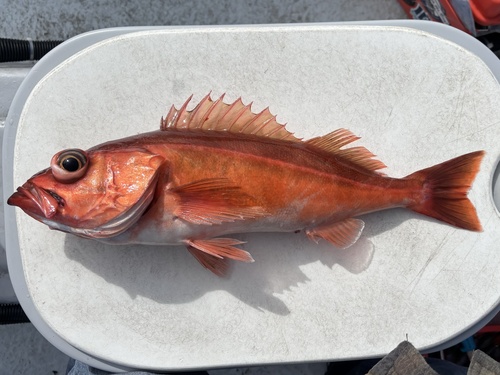
Chilipepper
Sebastes goodei
A vibrant splash of red in the deep blue, the Chilipepper rockfish is a social deep-sea species known for its schooling behavior and sleek, elongated profile. Found along the rugged Pacific coast, it is a favorite for deep-water explorers and sustainable fisheries alike.
Quick Identification
Size
Typically 30-45 cm (12-18 inches), reaching a maximum of 59 cm (23 inches) and up to 2.4 kg (5.3 lbs).
Colors
Uniformly pink to bright red on the back and sides, fading to a silvery-white belly; distinct clear or light-colored lateral line.
Key Features
- Slender, elongated body compared to other rockfish
- Lower jaw protrudes with a small knob at the tip
- Large eyes adapted for deep-water light
- Lateral line appears as a distinct light stripe along the body
When You’ll See Them
Geographic range
Where Does the Chilipepper Live?
The Chilipepper rockfish is a native resident of the eastern Pacific Ocean, hugging the western coastline of North America. Its range extends from the temperate waters off Vancouver Island in British Columbia, Canada, southward through the nutrient-rich currents of Washington, Oregon, and California, ultimately reaching as far as central Baja California, Mexico. While they are found along this entire stretch, they are most concentrated in central and southern California, where the deep canyons of the continental shelf provide the perfect sanctuary.
Basemap © OpenStreetMap contributors
Behavior
The Chilipepper rockfish is a highly social, schooling species that distinguishes itself from its more sedentary rockfish relatives by its active, pelagic lifestyle. Unlike the bottom-dwelling species that hide in crevices, Chilipeppers are often found hovering in large aggregations in the water column above rocky banks or deep-sea canyons. They exhibit a vertical migration pattern, often moving higher in the water column at night to follow the movement of their prey.
In terms of social structure, they are frequently found in mixed schools with other species like the Bocaccio. While they are generally wary of large predators, they show little aggression toward humans, though their depth makes direct interaction rare outside of scientific research or deep-sea diving. They are long-lived, with some individuals reaching ages of 35 years or more, maturing slowly and reproducing via internal fertilization—a unique trait among many fish where the females release live larvae rather than eggs.
EverydayEarth exclusive
Camera Tips
Capturing the Chilipepper rockfish requires specialized equipment due to their deep-water habitat. For coastal residents with access to a pier or boat, a 'drop camera' or a tethered underwater ROV is the best tool. Focus your efforts on areas where the seafloor drops off sharply into canyons or near rocky outcroppings. Using a camera with high-intensity LED lights is essential, as the red spectrum is the first to disappear at depth, making the 'chili' color of the fish appear grey or black without artificial illumination.
To attract these fish to your lens, use a perforated bait jar filled with oily fish like sardines or mackerel. The scent trail (chum) will draw schooling Chilipeppers from the surrounding water column. Because they are schooling fish, once you spot one, you are likely to see dozens. Set your camera to a high frame rate to capture their quick, darting movements as they compete for the bait scent.
Nighttime deployments can be particularly rewarding. As the Chilipepper follows the 'deep scattering layer' of plankton and small prey upward, you can often capture them at shallower depths (50-100m) than during the day. Ensure your camera rig is weighted properly to avoid drifting in heavy coastal currents, and use a wide-angle lens to capture the scale of the schools moving through the frame.
Similar Species
Species that look similar or are commonly confused with Chilipepper.
Frequently Asked Questions
Record Chilipepper at your habitat
Connect a camera to start building your own species record — AI identifies every visitor automatically.