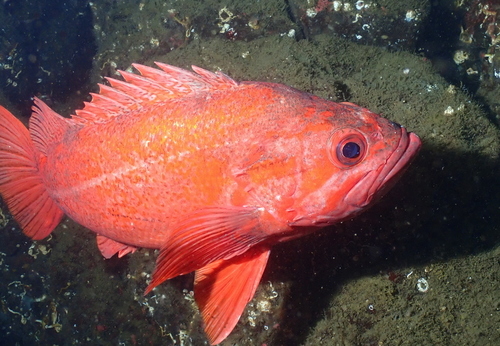
Vermilion Rockfish
Sebastes miniatus
A masterpiece of the deep Pacific, the Vermilion Rockfish is famous for its stunning red scales and long-lived nature. Often found patrolling rocky reefs, this 'red snapper' of the West Coast is a favorite for underwater observers.
Quick Identification
Size
Grows up to 36 inches (91 cm) in length and can weigh up to 15 lbs (6.8 kg).
Colors
Brilliant red to orange-red body with dusky or blackish mottling on the back and sides; fins often have a dark edge.
Key Features
- Vibrant red or vermilion body with greyish mottling
- Three dark stripes radiating from the eyes across the head
- Strong, sharp spines on the dorsal and anal fins
- Lower jaw is rough to the touch when rubbed forward
When You’ll See Them
Behavior
The Vermilion Rockfish is a patient predator that spends much of its time hovering near rocky reefs, boulders, and kelp forests. While they are generally solitary or found in small groups, they are known to congregate around high-relief structures that provide cover from larger predators. They are relatively slow-moving but capable of quick bursts of speed when striking at passing prey.
As a long-lived species, some individuals can reach ages of over 60 years. They are highly territorial regarding their preferred 'hangouts' on a reef. For those with underwater cameras mounted to piers or docks, these fish are often the 'sentinels' of the structure, staying in the frame for long periods while watching the camera with curious, large eyes.
EverydayEarth exclusive
Camera Tips
Capturing high-quality footage of a Vermilion Rockfish requires an underwater camera setup, such as those mounted to a dock piling or a weighted seafloor rig. Because these fish are attracted to structure, place your camera near rocky crevices or artificial reef modules. If you are filming at depths greater than 30 feet, the vibrant red color of the fish will appear grey or brownish due to the loss of the red light spectrum underwater. To see their true 'vermilion' hue, use a camera with high-intensity underwater LEDs or a red-filter lens.
Since Vermilion Rockfish are curious but cautious, avoid moving the camera once it is set. They are known to investigate stationary objects, so a fixed mounting position on a pier leg is ideal. Use a wide-angle lens to capture their environment, as they like to hover just on the edge of rocky drop-offs. If the current is strong, ensure your housing is streamlined to prevent vibration, which can spook the fish.
For the best results, aim your camera horizontally rather than looking straight down. This captures the fish's profile and the distinct dark stripes across its head. If you are using a bait cage to attract them, oily fish like sardines or chopped squid work best, but check local regulations first, as many marine protected areas prohibit feeding or baiting wildlife. Early morning light provides the best natural shimmer on their scales in shallower water.
Similar Species
Species that look similar or are commonly confused with Vermilion Rockfish.
Canary Rockfish
Has a bright white or grey lateral line and more yellowish-orange tones compared to the deep red of the Vermilion.
Yelloweye Rockfish
Features bright yellow eyes and two light-colored horizontal stripes along its body, which Vermilions lack.
Bocaccio
Has a much longer lower jaw and a more elongated, dusky-colored body compared to the stocky, bright red Vermilion.
Frequently Asked Questions
Record Vermilion Rockfish at your habitat
Connect a camera to start building your own species record — AI identifies every visitor automatically.