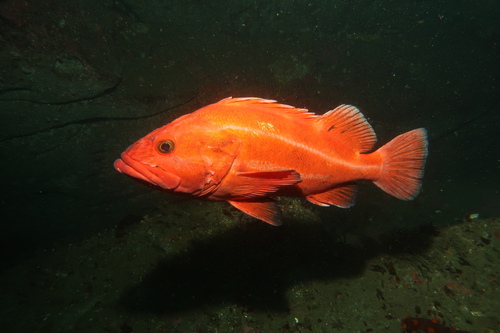
Yelloweye Rockfish
Sebastes ruberrimus
One of the longest-living creatures on the planet, the Yelloweye Rockfish is a vibrant, orange-hued sentinel of the deep Pacific reefs. Known for its striking golden eyes and a lifespan that can exceed a century, seeing one is like catching a glimpse of living history.
Quick Identification
Size
Typically 24–36 inches (60–91 cm) in length; can weigh up to 25 lbs (11.3 kg).
Colors
Bright orange to reddish-orange body with a distinctive bright yellow iris. Juveniles are darker red with two white horizontal stripes along their sides.
Key Features
- Brilliant golden-yellow eyes
- Bright orange to flame-red body coloration
- Two raspy ridges on the head above the eyes
- Square-shaped (truncate) tail fin
When You’ll See Them
Behavior
Yelloweye Rockfish are the legendary 'old souls' of the Pacific reef. They are exceptionally long-lived, with some individuals reaching ages of 120 years or more. Because they grow so slowly and reach sexual maturity late in life, they are often the elder statesmen of their underwater communities. They are highly sedentary and territorial; once an adult Yelloweye finds a high-quality rocky crevice or boulder pile, it may remain within a few hundred meters of that spot for decades.
In terms of social interaction, they are generally solitary and can be quite aggressive toward intruders who venture too close to their preferred 'den.' While they aren't social in the traditional sense, they are a vital part of the reef ecosystem, acting as a top-tier predator that keeps smaller fish populations in check. For humans, they are a prized sight for divers and a protected species in many areas due to their vulnerability to overfishing.
EverydayEarth exclusive
Camera Tips
Capturing the Yelloweye Rockfish requires specialized underwater equipment, as these fish reside at depths far beyond the reach of standard backyard gear. For those using underwater drop-cameras or ROVs (Remotely Operated Vehicles) near coastal rocky drop-offs, placement is everything. Aim your lens at high-relief structures—places where large boulders stack on top of one another to create deep, dark crevices. Yelloweye love to sit just inside or right in front of these 'doorways' waiting for prey to drift by.
Lighting is your biggest challenge at depth. While many underwater cameras use bright white LEDs, these can sometimes startle rockfish or cause 'backscatter' (reflecting off particles in the water). If your camera supports it, use a red-light filter or dimmable lights. Because Yelloweye are territorial, they are actually quite curious. If you leave a stationary camera in place, they will often emerge from their dens to inspect the device, giving you a perfect head-on shot of their namesake yellow eyes.
Timing is less about the season and more about the current. Use a weighted 'drop-cam' setup during 'slack tide' when the underwater current is weakest. This prevents your camera from spinning and allows the sediment to settle, resulting in a much clearer image. If you are trying to attract one for a photo, a small mesh bag of crushed herring or squid attached near the camera (but not blocking the lens) can draw them out of hiding, though their natural curiosity often suffices.
Finally, ensure your camera is set to a high frame rate. While the fish themselves move slowly and majestically, the underwater environment is constantly shifting. A higher frame rate will help the AI-detection software distinguish the bright orange of the fish from the swaying kelp or moving shadows of the reef, ensuring you get a crisp, clear notification when this deep-sea orange giant makes an appearance.
Similar Species
Species that look similar or are commonly confused with Yelloweye Rockfish.
Canary Rockfish
Has a more mottled orange-grey body and lacks the brilliant yellow iris of the Yelloweye.
Vermilion Rockfish
Features a mottled red body with dark grey or black edges on the fins and lacks the specific bright yellow eye.
Tiger Rockfish
Easily distinguished by its bold vertical dark stripes and much more secretive behavior in shallower waters.
Frequently Asked Questions
Record Yelloweye Rockfish at your habitat
Connect a camera to start building your own species record — AI identifies every visitor automatically.