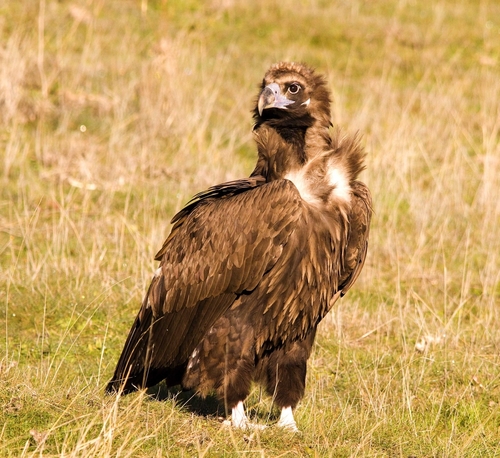
Cinereous Vulture
Aegypius monachus
The 'Monk of the Skies' is a shadow over the mountains, boasting a ten-foot wingspan that makes it the largest bird of prey in the Old World. Witness the silent power of Eurasia's ultimate scavenger.
Quick Identification
Size
Length: 100-120 cm (39-47 in); Wingspan: 250-310 cm (8.2-10.2 ft); Weight: 7-14 kg (15.4-31 lbs)
Colors
Uniform dark brown to blackish-brown body; pale grayish-pink skin on the head and neck; dark cere (beak base) and a massive black-tipped bill.
Key Features
- Enormous wingspan with deeply 'fingered' primary feathers
- Pale downy or bald head with a distinct dark 'mask' around the eyes
- Broad, rectangular wings that appear flat in flight
- Massive, powerful bill designed for tearing tough hide
When You’ll See Them
Geographic range
Where Does the Cinereous Vulture Live?
The Cinereous Vulture is native to a vast stretch of temperate Eurasia, ranging from the Iberian Peninsula in the west to the mountains of Mongolia and the Korean Peninsula in the east. It finds its stronghold in the rugged landscapes of Spain, Greece, Turkey, and across the Central Asian steppes into China. While many populations are resident year-round, birds in the northernmost parts of their range may wander southward into northern India or Southeast Asia during the harshest winter months.
Basemap © OpenStreetMap contributors
Behavior
The Cinereous Vulture, often called the 'Monk Vulture' due to the ruff of feathers around its neck resembling a cowl, is a solitary and majestic scavenger. Unlike many other vulture species that congregate in large, noisy groups, the Cinereous Vulture is more likely to be seen alone or in pairs. When it does join a feeding frenzy at a carcass, it is typically the dominant bird, using its immense size and strength to push aside smaller scavengers and even other vulture species.
These birds are masterful gliders, spending hours on the wing without a single flap. They rely on thermal updrafts to reach incredible altitudes, where they use their keen eyesight to monitor both the ground for food and the behavior of other scavengers like ravens or smaller vultures. While they are generally silent, they may emit grunts or hisses when competing for food. They are exceptionally wary of human presence and require large, undisturbed territories for nesting.
EverydayEarth exclusive
Camera Tips
To capture a Cinereous Vulture on camera, you need to think big and high. These birds are extremely cautious and rarely approach human dwellings, so your camera should be placed in remote, elevated areas like hilltops or overlooking wide-open valleys. Because of their massive 10-foot wingspan, avoid placing cameras in dense brush where the bird cannot land; instead, look for large, flat rocks or 'deaden' trees where they might perch to sun themselves or scout for food.
Placement height is critical. If you are monitoring a known nesting site (usually in the canopy of large pines or oaks), mount your camera on a neighboring tree at a similar height, ensuring at least 15-20 feet of distance to avoid disturbing the birds. For ground-level activity, aim the camera slightly upward to capture the bird's approach, as their landing sequence is long and dramatic. Use a wide-angle lens setting if your AI camera supports it, otherwise, you may only capture a frame full of dark feathers.
In many regions, 'vulture restaurants' or managed feeding stations are the best places for camera traps. If you are on private land where it is legal, placing a camera near a carcass is highly effective. Set your camera to a high trigger speed or 'burst mode,' as these vultures are surprisingly fast when taking off. Since they rely on mid-day thermals to fly, set your active hours for the middle of the day. Avoid using high-glow infrared flashes at night; while they aren't active then, the visible red glow can spook them from a roosting site.
Similar Species
Species that look similar or are commonly confused with Cinereous Vulture.
Frequently Asked Questions
Record Cinereous Vulture at your habitat
Connect a camera to start building your own species record — AI identifies every visitor automatically.