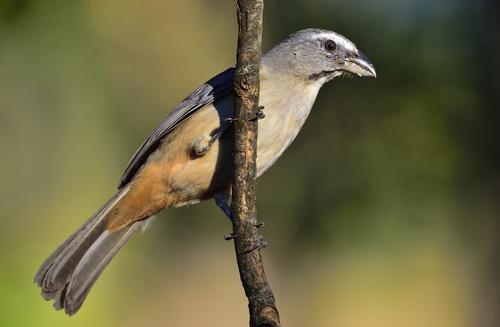
Cinnamon-bellied Saltator
Saltator grandis
A melodious and bold resident of tropical gardens, the Cinnamon-bellied Saltator is easily identified by its striking white eyebrow and warm, cinnamon-hued underparts. Thriving in forest edges and backyards alike, this vocal bird is a centerpiece of Central American birdwatching.
Quick Identification
Size
20–22 cm (8–8.7 in) in length; weight 50–65 g (1.7–2.3 oz)
Colors
Slate-grey upperparts, creamy white throat, bold white eyebrow (supercilium), and distinctive cinnamon-orange belly and undertail coverts.
Key Features
- Large, thick black bill with a slight hook
- Bold white eyebrow line above the eye
- Warm cinnamon-buff belly and vent
- White throat patch framed by dark malar 'mustache' stripes
When You’ll See Them
Geographic range
Where Does the Cinnamon-bellied Saltator Live?
Native to the Americas, the Cinnamon-bellied Saltator is found from northeastern Mexico through the Caribbean and Pacific slopes of Central America. Its core range extends through Belize, Guatemala, Honduras, and Nicaragua, reaching its southern limit in central Panama. Unlike many forest specialists, this species thrives in 'disturbed' habitats, making it a common resident in rural towns and suburban green spaces across the Neotropics.
Basemap © OpenStreetMap contributors
Behavior
The Cinnamon-bellied Saltator is a conspicuous and highly vocal bird, often first noticed by its rich, whistling song. While it belongs to the tanager family, it behaves much like a large finch, frequently perching on exposed branches to defend its territory or call to a mate. They are socially monogamous and are typically seen in pairs or small family groups, moving through the mid-story of trees and shrubs with a steady, hopping rhythm.
In human-inhabited areas, these birds are remarkably bold and have adapted well to suburban life. They are not easily startled and will often continue feeding while being observed. Their social interactions are characterized by frequent tail-flicking and soft 'chip' notes as they move through garden edges. Despite their size, they are agile foragers, easily navigating dense secondary growth to find ripening fruit or emerging insects.
EverydayEarth exclusive
Camera Tips
To capture high-quality footage of the Cinnamon-bellied Saltator, place your camera near fruiting trees or shrubs such as figs, berries, or ornamental bananas. These birds are mid-level foragers, so the ideal mounting height is between 4 and 6 feet (1.2 to 1.8 meters) above the ground. Angle the camera toward a horizontal 'staging branch' near a food source, as they often pause there to scan the area before feeding.
During the dry season, water is an incredible lure. A birdbath or a shallow dripping water feature will attract Cinnamon-bellied Saltators for both drinking and bathing. Position your camera to capture a side profile of the bird to highlight the contrast between its slate-grey back and warm cinnamon belly. Because they are vocal, using a camera with a high-quality microphone can capture their melodious, flute-like songs, which are most frequent in the early morning.
For baiting, these birds are particularly fond of halved oranges, papayas, or bananas placed on a platform feeder. Set your camera to a high trigger speed or use video mode, as they can be jerky in their movements when competing with other species for food. Since they are year-round residents, you can capture interesting seasonal behaviors, such as pair-bonding and feeding fledglings, by maintaining a consistent camera location throughout the year.
Similar Species
Species that look similar or are commonly confused with Cinnamon-bellied Saltator.
Frequently Asked Questions
Record Cinnamon-bellied Saltator at your habitat
Connect a camera to start building your own species record — AI identifies every visitor automatically.