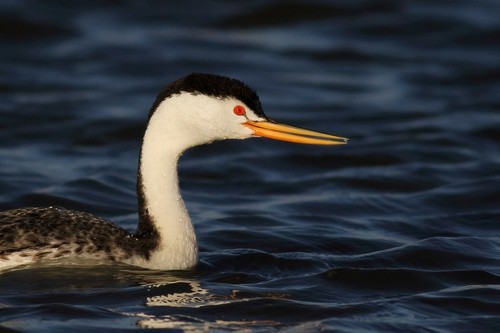
Clark's Grebe
Aechmophorus clarkii
Master of the water dance, the Clark's Grebe is a vision of elegance on Western lakes. Known for sprinting across the water in perfectly synchronized pairs, this striking waterbird is a favorite for backyard lake-watchers.
Quick Identification
Size
Length: 22-29 inches (56-74 cm); Wingspan: 30-34 inches (76-86 cm); Weight: 2.4-3.3 lbs (1.1-1.5 kg)
Colors
Striking black and white plumage; pure white throat and neck; bright yellow to orange-yellow bill; black cap that sits above the eye
Key Features
- Bright orange-yellow bill
- White feathers surrounding the red eye
- Long, swan-like white neck
- Graceful, slender profile during dives
When You’ll See Them
Geographic range
Where Does the Clark's Grebe Live?
The Clark's Grebe is a quintessential bird of western North America. It breeds primarily in the inland lakes of the western United States and southwestern Canada, with significant populations found in California, Oregon, and the Great Basin. During the winter, these birds migrate to the Pacific coast, ranging from southern British Columbia down to central Mexico, where they also inhabit several large highland lakes year-round.
Basemap © OpenStreetMap contributors
Behavior
Outside of courtship, they are highly social birds that nest in large colonies, sometimes numbering in the hundreds. They are dedicated parents; once the chicks hatch, they immediately climb onto a parent's back. The adults will swim and even dive with the chicks tucked securely under their wings, a behavior known as 'back-brooding' that protects the young from predators and cold water. While they are powerful flyers, they are awkward on land because their legs are positioned far back on their bodies for efficient diving.
EverydayEarth exclusive
Camera Tips
AI-powered cameras should be set to high-sensitivity motion detection, as grebes can move surprisingly fast across the frame. If your camera supports high-frame-rate video (60fps or higher), use it to capture the incredible detail of their 'rushing' courtship displays. Since grebes are sensitive to human presence, a camera with a good telephoto range or a cellular trail cam that doesn't require frequent SD card swaps is ideal to minimize disturbance near nesting sites.
Baiting is not recommended for grebes, as they hunt live fish, but you can increase your chances by scouting 'travel lanes.' Grebes often follow the same paths through gaps in rushes or lilies to reach open water. Positioning your camera at these natural bottlenecks during the breeding season (May-July) is the most effective way to see the chicks riding on their parents' backs. Early morning light is your best friend; the calm water provides mirror-like reflections that make for stunning, high-contrast imagery against their white plumage.
Similar Species
Species that look similar or are commonly confused with Clark's Grebe.
Western Grebe
The Western Grebe has a darker, olive-colored bill and the black of its cap extends down below the eye.
Horned Grebe
Much smaller with a shorter neck and distinctive golden 'horns' of feathers during the breeding season.
Red-necked Grebe
Has a thicker neck, a stouter bill, and a namesake chestnut-red neck during the summer.
Frequently Asked Questions
Record Clark's Grebe at your habitat
Connect a camera to start building your own species record — AI identifies every visitor automatically.