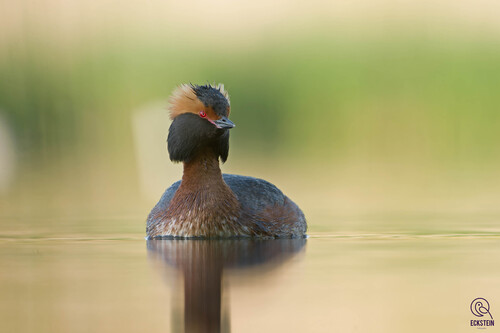
Horned Grebe
Podiceps auritus
Transforming from sleek winter monochrome to a fiery-necked summer spectacle, the Horned Grebe is one of the most charismatic divers of the northern wetlands. Known for its golden 'horns' and tender parenting, this vulnerable species is a true prize for any backyard observer.
Quick Identification
Size
Length: 31–38 cm (12–15 in); Wingspan: 59–65 cm (23–26 in); Weight: 300–570 g (11–20 oz)
Colors
Breeding adults feature striking golden-yellow 'horns' against a black head, a chestnut neck, and reddish flanks. In winter, they transition to a crisp black-and-white pattern with a distinct white cheek.
Key Features
- Golden-yellow feather tufts behind the eyes in breeding plumage
- Short, straight bill with a distinct pale tip
- Vivid red eyes
- Sharp black-and-white contrast on the face during winter
When You’ll See Them
Geographic range
Where Does the Horned Grebe Live?
Native to the Northern Hemisphere, the Horned Grebe maintains a vast circumpolar range across North America and Eurasia. In the West, they are most common throughout Canada, Alaska, and the northernmost United States, while their Eurasian counterparts span from Iceland and Scandinavia across the Russian wilderness to the Pacific coast. They are a highly migratory species, traveling south to find ice-free coastal waters along the Atlantic and Pacific oceans during the colder months.
Basemap © OpenStreetMap contributors
Behavior
The Horned Grebe is a highly specialized waterbird, spending nearly its entire life afloat. They are renowned for their elaborate courtship rituals, which include synchronized swimming and the 'weed dance,' where pairs rise out of the water chest-to-chest holding bits of vegetation. Once their chicks hatch, parents often carry them on their backs, tucked securely under their wings for protection and warmth.
These birds are expert divers, using their large, lobed feet—rather than webbed ones—to propel themselves underwater in search of prey. They are generally solitary or found in pairs during the breeding season but can form small, loose flocks during migration or on their wintering grounds in coastal bays. While they are capable flyers, they require a long running start across the water's surface to become airborne.
EverydayEarth exclusive
Camera Tips
Capturing the Horned Grebe requires a camera setup focused on the water's edge. If you have a backyard pond or live near a wetland, the best approach is to mount your AI camera on a low-profile stake or a floating platform. Because grebes sit very low in the water, a camera positioned just 6-12 inches above the water level provides the most intimate and professional-looking perspective. Use a wide-angle lens for birds close to the shore or a telephoto lens if your camera is fixed on a dock overlooking a larger body of water.
Since these birds are attracted to calm, vegetated areas for nesting, aim your camera at openings in reeds or lilies. They are wary of movement on land, so a permanent, camouflaged camera housing is much more effective than a handheld approach. You don't need traditional bait for grebes, as they are active hunters, but maintaining a healthy pond ecosystem that supports aquatic insects and small minnows will naturally encourage them to linger within your camera's frame.
Lighting is crucial for this species, especially to capture the vivid red of their eyes and the golden shimmer of their 'horns.' Set your camera's high-activity triggers for the first two hours after sunrise when the light is soft and the water is typically at its calmest. In winter, look for them in coastal areas; a camera mounted on a pier or a sheltered cove can capture their striking monochrome winter plumage as they dive for small fish.
Similar Species
Species that look similar or are commonly confused with Horned Grebe.
Eared Grebe
Eared Grebes have a thinner, upturned bill and more diffused, fan-like yellow facial feathers that cover the cheek rather than forming a distinct 'horn' behind the eye.
Pied-billed Grebe
Much stockier with a thick, chicken-like bill and lacks the vibrant golden tufts or chestnut neck of the Horned Grebe.
Frequently Asked Questions
Record Horned Grebe at your habitat
Connect a camera to start building your own species record — AI identifies every visitor automatically.