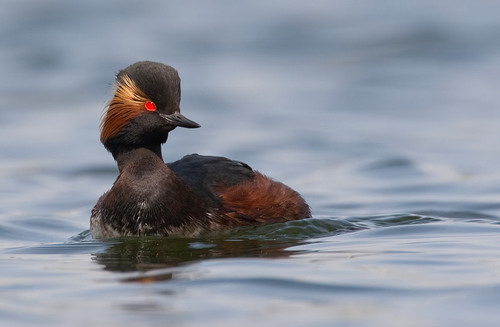
Eared Grebe
Podiceps nigricollis
With their fiery red eyes and golden 'ear' fans, Eared Grebes are the jewels of the marsh. Watch as these master divers transform through the seasons, moving in massive, synchronized flocks across the world's lakes.
Quick Identification
Size
Length: 28–34 cm (11–13 in), Wingspan: 56–60 cm (22–24 in), Weight: 230–450 g (8–16 oz)
Colors
Breeding adults have a black head and neck with fan-like golden-yellow feathers behind the eyes. Non-breeding adults are grey-black above with white undersides and a distinct white ear patch. Both sexes feature vibrant red eyes.
Key Features
- Distinctive fan-shaped golden ear tufts in breeding season
- Bright ruby-red iris
- Thin, slightly upturned black bill
- Fluffy rear end that sits high on the water
When You’ll See Them
Geographic range
Where Does the Eared Grebe Live?
The Eared Grebe is a globetrotting species found across North America, Eurasia, and parts of Africa. In North America, they are a staple of the western interior, breeding in the wetlands of the United States and Canada before congregating in massive numbers at saline sites like the Great Salt Lake. Across the Atlantic, the species—often called the Black-necked Grebe—spans from Western Europe through Central Asia, with additional resident populations in East and South Africa.
Basemap © OpenStreetMap contributors
Behavior
Eared Grebes are highly social water birds, often found in large colonies that can number in the thousands, especially during their spectacular migration stopovers. Unlike many other birds, they undergo a unique physiological transformation before migrating; they double their body weight and their internal organs shrink to accommodate massive fat stores, rendering them flightless for months at a time. This makes them one of the most efficient, yet specialized, migrators in the avian world.
On the water, they are expert divers, frequently disappearing beneath the surface for up to 30 seconds to forage. They are rarely seen on land because their legs are positioned far back on their bodies—an evolutionary trait that makes them powerful swimmers but clumsy walkers. In a backyard setting with a pond or lake, you will see them constantly preening their dense, waterproof feathers to maintain buoyancy.
EverydayEarth exclusive
Camera Tips
Capturing Eared Grebes on camera requires a low-profile approach since they are low-floating water birds. For the best results, mount your camera just a few inches above the water level on a dock, a sturdy lakeside stake, or even a floating platform. A low angle provides that intimate, professional-looking perspective that highlights their striking red eyes and golden ear tufts against the water's surface reflection.
Standard PIR (motion) sensors can struggle with water birds because the water surface itself can trigger the sensor or the bird's heat signature may be masked by the cool environment. To overcome this, use a 'Time Lapse' mode set to take a photo every 30 to 60 seconds during the first three hours of daylight. This ensures you capture them even if they are diving or swimming quietly past the sensor's range.
Because Eared Grebes do not visit traditional bird feeders, you cannot lure them with seed. Instead, focus your camera on areas with floating vegetation or near the edges of reed beds where they tend to build their floating nests. If your backyard overlooks a pond, try to position the camera so the morning sun is behind you; this 'front-lighting' will make their crimson eyes pop and reveal the intricate texture of their breeding plumage.
Similar Species
Species that look similar or are commonly confused with Eared Grebe.
Horned Grebe
The Horned Grebe has a thicker, straight bill and the yellow feathers form a distinct 'horn' rather than a wispy fan.
Pied-billed Grebe
Much stockier with a thick, chicken-like bill and lacks the bright red eyes and golden ear tufts.
Western Grebe
Significantly larger with a much longer, swan-like neck and a long, yellow bill.
Frequently Asked Questions
Record Eared Grebe at your habitat
Connect a camera to start building your own species record — AI identifies every visitor automatically.