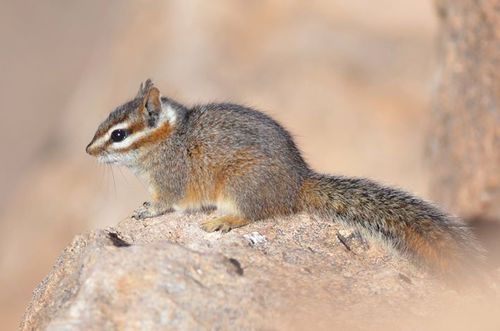
Cliff Chipmunk
Neotamias dorsalis
Meet the mountain athlete of the American Southwest. The Cliff Chipmunk is a master of vertical terrain, turning sheer rock walls into its personal playground.
Quick Identification
Size
Total length: 21–25 cm (8.3–9.8 in); Weight: 50–70 g (1.8–2.5 oz)
Colors
Grayish-brown upperparts with a dark central dorsal stripe; side stripes are very faint or absent; belly is creamy white; tail is bushy and gray with white-tipped hairs.
Key Features
- Indistinct or faint side stripes compared to other chipmunks
- Pronounced dark stripe running down the center of the back
- Bushy, grayish tail often held vertically when running
- Specialized for climbing vertical rock faces
When You’ll See Them
Geographic range
Where Does the Cliff Chipmunk Live?
The Cliff Chipmunk is a native of the interior Western United States and Northern Mexico. Its core range spans the rugged landscapes of Arizona, New Mexico, Utah, and Nevada, reaching south through the Sierra Madre Occidental in Mexico. You will primarily find them where arid woodlands meet steep, rocky topography, creating a perfect vertical playground for these agile climbers.
Basemap © OpenStreetMap contributors
Behavior
The Cliff Chipmunk is the mountain athlete of the rodent world. While most chipmunks are associated with forest floors, this species is a vertical specialist, perfectly adapted for life among sheer canyon walls and boulder fields. They are incredibly agile, using their sharp claws to scale steep rock faces that would leave other mammals grounded. Unlike many other ground squirrels, they do not hibernate deeply or store massive amounts of body fat, instead relying on their wits and hidden pantries to survive the winter.
These chipmunks are known for being "scatter-hoarders." They spend their autumn days frantically collecting seeds and nuts, which they stash in hundreds of tiny crevices across their rocky territory. During the winter, they remain somewhat active, waking up during warmer spells to visit these caches. They are generally shy and alert, often using high rocky vantage points to keep a lookout for predators like hawks or snakes, letting out a sharp, high-pitched 'chip' to warn others of danger.
EverydayEarth exclusive
Camera Tips
To capture the Cliff Chipmunk on camera, placement is everything. Don't just look at the ground; look for "transit points" along rocky ledges or at the base of large boulder piles. Position your AI camera about 12-18 inches off the ground, angled slightly upward if you're placing it near a rock face. Since they are small and remarkably fast, a high trigger speed (under 0.3 seconds) is essential to catch them before they zip out of the frame.
Baiting can be very effective in rocky backyard environments. A small pile of unsalted sunflower seeds or pinyon nuts placed on a flat "stage" rock will encourage them to pause long enough for a clear photo. If you are in a particularly dry area, providing a shallow water source or a ground-level birdbath near rock cover will act as a powerful magnet, especially during the hot afternoon hours when they seek hydration between foraging runs.
Lighting can be tricky in canyons or near cliffs due to harsh, high-contrast shadows. Try to place your camera in a spot that receives filtered light through pinyon branches or use a model with a good dynamic range. These chipmunks are most active in the mid-morning and late afternoon, so ensure your camera lens isn't facing directly into the rising or setting sun, which can cause lens flare and wash out their subtle stripe patterns.
Similar Species
Species that look similar or are commonly confused with Cliff Chipmunk.
Uinta Chipmunk
Has much bolder, more distinct white and dark side stripes and prefers denser forest cover.
Least Chipmunk
Noticeably smaller with high-contrast stripes that run all the way to the base of the tail.
Rock Squirrel
Significantly larger (the size of a tree squirrel) and lacks the facial and back stripes characteristic of chipmunks.
Frequently Asked Questions
Record Cliff Chipmunk at your habitat
Connect a camera to start building your own species record — AI identifies every visitor automatically.