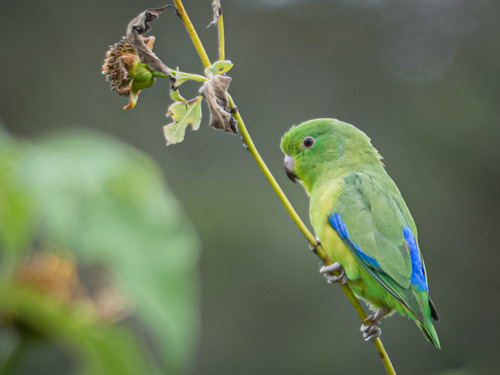
Cobalt-rumped Parrotlet
Forpus xanthopterygius
The Cobalt-rumped Parrotlet is a charming 'pocket parrot' of South America, beloved for its social nature and the male's hidden flashes of brilliant blue. These tiny green gems are common backyard visitors across Brazil and beyond.
Quick Identification
Size
12–13 cm (4.7–5.1 in) in length; weighs approximately 24–30 g (0.8–1.1 oz)
Colors
Bright leaf-green body; males feature striking cobalt blue on the primary coverts and rump; females are entirely green with yellowish-green faces
Key Features
- Diminutive 'pocket parrot' size
- Short, wedge-shaped tail
- Vibrant cobalt blue wing and rump patches on males
- Pale, horn-colored bill
When You’ll See Them
Geographic range
Where Does the Cobalt-rumped Parrotlet Live?
Native to the diverse landscapes of South America, the Cobalt-rumped Parrotlet is primarily found throughout central and eastern Brazil, extending southward into Paraguay and northeastern Argentina. These charming birds thrive in the transition zones where forests meet open country, often making themselves at home in suburban parks and gardens within their native range. While they are sedentary residents across most of their territory, they may move locally in response to the seasonal ripening of fruit and seeds.
Basemap © OpenStreetMap contributors
Behavior
Cobalt-rumped Parrotlets are highly social and energetic birds that are almost always found in pairs or small flocks. They spend a significant portion of their day foraging in the mid-to-upper canopy but are not shy about descending to eye level in suburban gardens or scrubland. They communicate with a series of high-pitched chirps and 'tsit' notes that are surprisingly quiet compared to the raucous calls of larger parrots.
These birds are known for their strong pair bonds; mates can often be seen perched closely together, engaging in mutual preening (allopreening) to reinforce their connection. While they are generally peaceful, they can become quite territorial during the nesting season, fiercely guarding tree hollows or even abandoned nests of other species like the Rufous Hornero.
EverydayEarth exclusive
Camera Tips
To capture the perfect shot of these tiny, fast-moving 'pocket parrots,' positioning is everything. Unlike larger parrots that stay high in the canopy, Cobalt-rumped Parrotlets often descend to lower shrubbery or garden feeders. Mount your AI camera approximately 5 to 7 feet off the ground, facing a known foraging spot like a fruiting fig tree or a birdbath. Because they are social and often travel in small, chatter-filled groups, a wide-angle lens setting is ideal to capture the whole flock rather than just a single individual.
Speed is your best friend when filming parrotlets. These birds are incredibly agile and rarely sit still for long. Set your camera to a high-speed trigger mode with a short recovery time between shots. If your camera supports it, a 'burst' photo mode or a high-frame-rate video setting (60fps or higher) will help you catch the moment a male flashes his brilliant blue wing feathers—the key identifying mark that often disappears when the bird is perched quietly.
Attracting them to a specific spot for your camera is most effective using water or specific fruit lures. A shallow, elevated birdbath with a small solar dripper is a magnet for these birds, as the sound of moving water is irresistible in drier climates. In terms of timing, focus your efforts on the 'golden hours' shortly after sunrise and just before sunset. They are most vocal and active during these windows, making them much easier for your AI software to detect and record.
Similar Species
Species that look similar or are commonly confused with Cobalt-rumped Parrotlet.
Frequently Asked Questions
Record Cobalt-rumped Parrotlet at your habitat
Connect a camera to start building your own species record — AI identifies every visitor automatically.