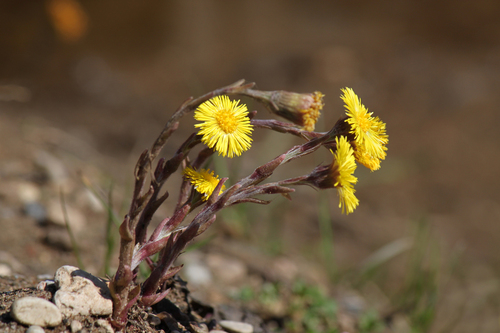
colt's-foot
Tussilago farfara
A golden harbinger of spring, Colt's-foot is famous for sending its bright yellow blooms to meet the sun before its leaves even break the soil.
Quick Identification
Size
Flower height 10–30 cm (4–12 in); leaves 10–20 cm (4–8 in) wide
Colors
Bright yellow flower heads; reddish or purplish scales on the flowering stems; deep green leaves with silvery-white woolly undersides.
Key Features
- Golden yellow flowers appear in early spring before any leaves emerge
- Flowering stems are covered in scale-like bracts rather than true leaves
- Distinctive hoof-shaped (cordate) leaves appear only after the flowers fade
- The underside of the leaf is covered in dense, white, felt-like hairs
When You’ll See Them
Geographic range
Where Does the colt's-foot Live?
Originally native to the temperate regions of Europe, North Africa, and parts of Western and Central Asia, Colt's-foot has expanded its footprint significantly over the centuries. It is now a common sight across much of North America, where it was introduced by early settlers and has since naturalized throughout the northern United States and southern Canada. It thrives in cool, temperate zones and is particularly fond of the nutrient-poor, damp soils found along roadside ditches and river corridors.
Basemap © OpenStreetMap contributors
Behavior
Colt's-foot is a unique perennial wildflower often referred to as 'filius ante patrem' (the son before the father) because its flowers emerge and wither before the leaves ever appear. As one of the very first plants to bloom in the spring, it often pushes through melting snow, providing a critical early food source for pollinators. The flowers are heliotropic, meaning they track the sun across the sky and close tightly during the night or during periods of heavy overcast or rain.
Once the flowering stage ends and the seeds—attached to white, feathery pappus—are dispersed by the wind, the plant shifts its energy into foliage. The large, broad leaves grow rapidly, often forming a dense canopy near the ground that suppresses the growth of other plants. This aggressive growth strategy, supported by a deep and creeping rhizome system, allows Colt's-foot to colonize unstable or disturbed ground where other species struggle to take root.
EverydayEarth exclusive
Camera Tips
To capture the dramatic spring emergence of Colt's-foot, set your AI camera to time-lapse mode during the late winter months. Position the camera at a low 'worm’s-eye' view, roughly 5–10 inches from the ground, focusing on patches of bare, damp earth or gravel where you noticed the plant the previous year. Because these golden flowers bloom before the green leaves, they provide a high-contrast subject against the brown, dormant soil of early spring.
Since the flowers are highly sensitive to light and weather, ensure your camera is positioned to receive direct sunlight. The blooms will remain closed and look like scaly stalks if they are in deep shade or if the weather is consistently gloomy. If you are using a trigger-based camera to catch wildlife, placing it near a cluster of Colt's-foot in March or April is a great strategy for capturing macro shots of early-season pollinators like mining bees and hoverflies, which are drawn to the nectar.
For the best visual detail, use a camera with a short focal length or macro capability to highlight the intricate purple scales on the stem and the fine white hairs on the leaves. If your camera allows for sensitivity adjustments, set it to high to catch the movement of insects visiting the flowers. In the summer, you can pivot your camera's focus to the large, hoof-shaped leaves, which provide excellent cover for ground-dwelling insects and small amphibians, often resulting in unique 'under-the-canopy' wildlife footage.
Similar Species
Species that look similar or are commonly confused with colt's-foot.
Dandelion
Dandelions have hollow, smooth stems and their jagged leaves are present when they bloom, unlike the scaly-stemmed, leafless Colt's-foot.
Winter Aconite
Winter Aconite blooms at a similar time but has a 'ruff' of green leaves immediately below the flower head.
Common Butterbur
Butterbur also flowers before its leaves, but the flowers are pinkish-purple and grow in dense, club-like clusters rather than single yellow heads.
Frequently Asked Questions
Record colt's-foot at your habitat
Connect a camera to start building your own species record — AI identifies every visitor automatically.