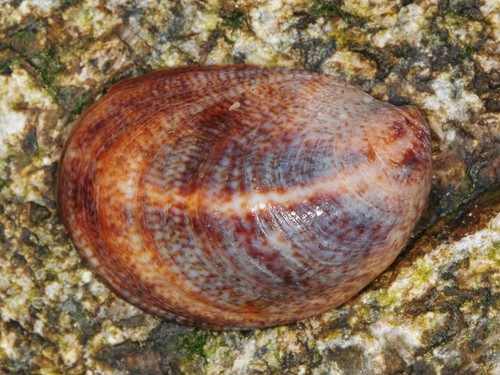
Common Atlantic Slippersnail
Crepidula fornicata
The architect of the intertidal zone, the Common Atlantic Slippersnail is famous for its leaning towers of shells and its fascinating ability to change sex as it grows. Found clinging to rocks and docks, it is a master of the stationary life.
Quick Identification
Size
2.5 to 5 cm (1 to 2 inches) in length
Colors
Varied shades of cream, tan, and light brown, often featuring reddish-brown spots or wavy streaks; the interior is polished white with a distinct translucent 'deck.'
Key Features
- Oval, slipper-like shell shape
- Internal horizontal shelf (the 'deck') covering half the opening
- Stacked growth habit where individuals sit on top of one another
When You’ll See Them
Geographic range
Where Does the Common Atlantic Slippersnail Live?
Native to the western Atlantic Ocean, the Common Atlantic Slippersnail is found from the cold waters of Atlantic Canada all the way south to the Gulf of Mexico. It is incredibly hardy and has successfully established itself as an invasive species in many parts of the world, including the coasts of the United Kingdom, France, and the Pacific coast of the United States. In these non-native regions, it often thrives in muddy bays and oyster-rich estuaries where it was accidentally introduced via the shellfish trade.
Basemap © OpenStreetMap contributors
Behavior
The Common Atlantic Slippersnail is best known for its unique 'stacking' behavior. These snails form curved towers of up to 10 or more individuals, often attached to a rock, a larger shell, or even a slow-moving horseshoe crab. This stacking is not just for space; it is central to their reproduction. They are protandrous hermaphrodites, meaning they begin life as males and transition into females as they grow. In a stack, the largest, oldest individuals at the bottom are female, while the smaller, younger ones at the top are male.
These mollusks are sedentary as adults, remaining in one spot for most of their lives. They are not aggressive and do not hunt; instead, they live a peaceful existence filtering the water column. While they are often viewed as a nuisance in European oyster beds where they are an invasive species, they play a vital role in their native ecosystems by providing complex habitats for other small marine creatures within their stacks.
EverydayEarth exclusive
Camera Tips
Capturing the Common Atlantic Slippersnail requires a specialized approach since they are marine organisms. If you live near a coastline or tidal estuary, use a waterproof action camera or an AI-powered camera in a submersible housing. The best placement is within a tide pool or a shallow area that remains submerged at high tide. Secure the camera to a heavy anchor or wedge it between rocks to prevent it from being swept away by the surf. Angle the lens slightly upward if they are on a rock, or downward if you are filming a stack on the sandy bottom.
Because these snails move very little, time-lapse photography is the most rewarding method. Set your camera to take a photo every 15 to 30 seconds. Over several hours, you will see the subtle expansion of their shells and the movement of their siphons as they filter-feed during the incoming tide. This also allows you to capture other visiting backyard marine life like crabs or small fish that interact with the snail stacks.
Lighting is crucial for underwater shots. Clear, sunny days provide the best natural light for shallow water. If your camera setup allows for it, a small external LED light can help highlight the reddish-brown patterns and the pearly interior of the shells. Always ensure the lens is clear of salt residue and algae before a session, as these can quickly blur the image in a marine environment.
Similar Species
Species that look similar or are commonly confused with Common Atlantic Slippersnail.
Frequently Asked Questions
Record Common Atlantic Slippersnail at your habitat
Connect a camera to start building your own species record — AI identifies every visitor automatically.