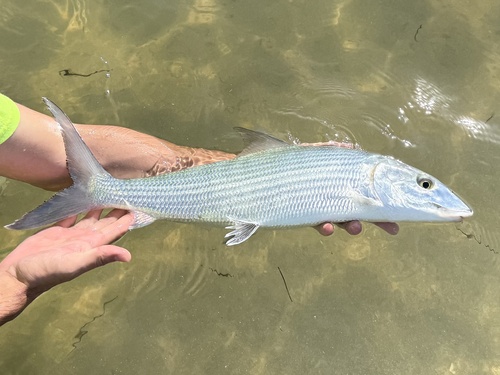
Common Bonefish
Albula vulpes
Meet the 'Ghost of the Flats,' a shimmering silver speedster that masters the art of camouflage in the world's shallowest tropical waters.
Quick Identification
Size
Typically 30-70 cm (12-28 inches) and 1.5-4.5 kg (3-10 lbs); trophy specimens can reach 100 cm (40 inches) and over 8 kg (18 lbs).
Colors
Mirror-like silver sides with a faint greenish or bluish back; subtle dark longitudinal streaks on the upper half; clear to dusky fins.
Key Features
- Conical, pig-like snout that overhangs the mouth
- Deeply forked, powerful tail fin
- Slender, torpedo-shaped body with mirror-like scales
- Small, inferior mouth positioned underneath the snout
When You’ll See Them
Geographic range
Where Does the Common Bonefish Live?
The Common Bonefish is a quintessential resident of the Western Atlantic's tropical and subtropical waters. They are most densely populated throughout the Bahamas and the Florida Keys, though their reach extends north to North Carolina and south through the Caribbean Sea to the coast of Brazil. Because they rely on warm, shallow ecosystems, they are frequently found in the island nations of the Antilles and the coastal flats of Central American countries like Belize and Mexico.
Basemap © OpenStreetMap contributors
Behavior
These fish are incredibly fast, capable of short bursts of speed up to 40 miles per hour to evade predators like sharks and barracudas. This speed, combined with their keen eyesight and sensitivity to vibrations, makes them one of the most challenging marine species to observe or photograph in the wild. They are constant wanderers, moving with the tides to access feeding grounds that are otherwise too shallow during low water.
While they are not a food fish for humans due to the hundreds of tiny 'intermuscular' bones that give them their name, they are the most prized catch-and-release sport fish in the tropical Atlantic. Their relationship with humans is primarily one of stealth and pursuit, as they are easily spooked by the sound of a boat engine or even a heavy footstep on a dock.
EverydayEarth exclusive
Camera Tips
Capturing the Common Bonefish on camera requires a specialized approach since they are strictly aquatic. For those with waterfront properties or access to docks in tropical regions, the best setup is a waterproof action camera mounted to a submerged piling or a weighted tripod placed on the sandy bottom. Position your camera in 'cuts' or channels where the water depth transitions from deep to shallow; these act as natural highways for bonefish as they move onto the flats with the rising tide.
Because bonefish are incredibly wary of new objects, camouflage is essential. Use a matte-colored housing—avoiding any shiny or white surfaces—and consider wrapping the mount in artificial seagrass or neutral-colored tape to break up its silhouette. For AI detection to work effectively, visibility is key; aim your camera toward a sandy patch rather than thick grass to provide a high-contrast background that makes the fish’s silver scales pop.
Lighting is your biggest challenge underwater. To avoid the 'blown out' look caused by surface glare, set your camera to record during the early morning or late afternoon when the sun hits the water at an angle. If you are using a trail camera with a waterproof box, ensure the lens is treated with a hydrophobic coating to prevent air bubbles or salt crystals from blurring the shot. Since you cannot use traditional bait, look for areas with naturally high concentrations of crabs or shrimp to increase your chances of a close-up.
Similar Species
Species that look similar or are commonly confused with Common Bonefish.
Frequently Asked Questions
Record Common Bonefish at your habitat
Connect a camera to start building your own species record — AI identifies every visitor automatically.