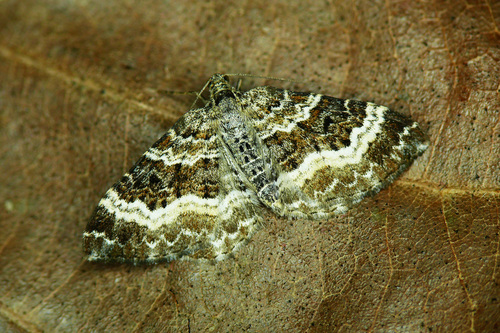
Common Carpet Moth
Epirrhoe alternata
The Common Carpet Moth is a beautifully intricate visitor to the nighttime garden, recognized by its striking monochrome bands and 'inchworm' larvae. A frequent guest at porch lights, it is a perfect subject for those exploring the hidden world of backyard entomology.
Quick Identification
Size
Wingspan of 27–30 mm (1.0–1.2 inches)
Colors
A pattern of alternating dark grey-brown and white bands; most distinctive for a broad white band with a thin grey line running through its center
Key Features
- Boldly patterned wings with alternating dark and light bands
- A broad white band containing a thin, faint grey wavy line
- A small black discal spot on each forewing
- Toothed or jagged edges on the dark bands
- Wings held flat and spread wide when at rest
When You’ll See Them
Geographic range
Where Does the Common Carpet Moth Live?
The Common Carpet is a widely distributed species native to the Palearctic realm, spanning across Europe, North Africa, and through Asia to the Near East. In North America, it is established as a common resident across the northern United States and throughout every province and territory of Canada. It is particularly successful in temperate regions where its primary host plants, such as bedstraw, are abundant in the undergrowth.
Basemap © OpenStreetMap contributors
Behavior
The Common Carpet is a primarily nocturnal moth, though it is one of the species most frequently encountered by people during the day. It has a habit of resting in low-growing vegetation or on the undersides of leaves, where it is easily flushed out by passing walkers or gardeners. When disturbed, it flies with a quick, fluttering motion for a short distance before diving back into the safety of the foliage.
During its active hours at night, it is a frequent visitor to backyard gardens, especially those with diverse wildflower populations. Like many geometrid moths, it is strongly attracted to artificial light sources. It does not exhibit complex social behaviors, living a solitary life centered around finding mates and suitable host plants for egg-laying. Despite the name 'carpet,' this moth is entirely outdoor-dwelling and poses no threat to household rugs or fabrics.
EverydayEarth exclusive
Camera Tips
To successfully capture the Common Carpet Moth on an AI-powered backyard camera, focus your efforts on light attraction. These moths are highly sensitive to UV and short-wavelength light. Setting up your camera near a white sheet illuminated by a porch light or a specialized actinic bulb will create a perfect stage. Place the camera on a tripod approximately 2 to 3 feet from the sheet to ensure the AI can resolve the fine 'toothed' patterns on the wings, which are essential for identification.
If you prefer a more naturalistic shot, position your camera near patches of bedstraw (Galium spp.) or garden flowers like Valerian or Honeysuckle. Use a low angle, roughly 1 to 2 feet off the ground, as these moths tend to stay low to the vegetation. Ensure your camera's infrared (IR) sensors are optimized for close-up triggers, as the small size of the moth might not trigger sensors designed for larger mammals at a distance.
Because the Common Carpet often has two 'flights' or generations per year—typically in late spring and again in mid-summer—you should increase your camera's activity during May and August. Adjust your settings to capture short, high-resolution video clips rather than still photos; the fluttering movement of the moth as it lands often provides better diagnostic views of the wing markings than a single, potentially blurry frame.
Similar Species
Species that look similar or are commonly confused with Common Carpet Moth.
Frequently Asked Questions
Record Common Carpet Moth at your habitat
Connect a camera to start building your own species record — AI identifies every visitor automatically.