Common Citronella Ant
Lasius claviger
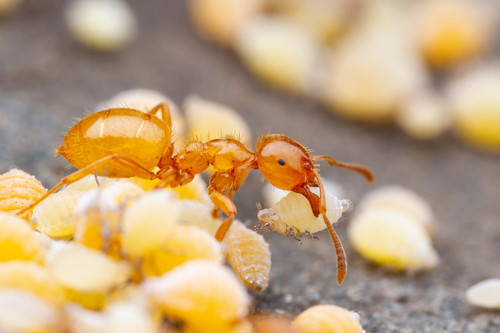
Meet the subterranean farmer of the insect world. Common Citronella Ants are famous for their brilliant golden color and a surprising lemony scent that serves as a secret weapon against predators.
Quick Identification
Size
Workers: 3–4.5 mm (0.12–0.18 in); Queens: 7–9 mm (0.28–0.35 in)
Colors
Workers are bright yellow to golden-orange; winged queens are dark reddish-brown to black
Key Features
- Distinct citronella or lemon-like scent when crushed
- Bright yellow to golden body color in workers
- Small, reduced compound eyes
- Winged reproductives (alates) appear in late summer or fall
When You’ll See Them
Geographic range
Where Does the Common Citronella Ant Live?
Native to the North American continent, the Common Citronella Ant is widely distributed across the temperate regions of the United States and southern Canada. Its core population is most dense throughout the Eastern United States, extending from the Atlantic coast westward into the Great Plains and northward into Ontario and Quebec. These ants are particularly common in the suburban landscapes of the Northeast and Midwest, where they thrive in the rich, moist soils of mature yards and parks.
Basemap © OpenStreetMap contributors
Behavior
The Common Citronella Ant is a fascinating subterranean species that spends the vast majority of its life underground. They are best known for the defensive chemical they produce—citronellal—which gives them a distinct lemony or citronella-like odor when they are disturbed or crushed. Unlike many other common ants, they are rarely seen foraging on the surface, making their sudden appearance during mating swarms a notable event for backyard observers.
These ants are non-aggressive and do not possess a sting that is harmful to humans. They live in large colonies, often situated under large rocks, rotting logs, or near the foundations of homes. Their social structure revolves around a hidden world of mutualism; they do not hunt for food in the traditional sense, but instead act as subterranean farmers, tending to insects that live on the roots of plants.
EverydayEarth exclusive
Camera Tips
Capturing the Common Citronella Ant on a backyard camera is all about timing, as they are subterranean for 99% of the year. The best opportunity occurs during 'nuptial flights' in late summer or early autumn. On warm, humid afternoons following a rain, look for hundreds of winged queens and smaller winged males emerging from cracks in the soil or along the edges of concrete slabs. Position your camera at ground level, focused on the exit hole, to capture the chaotic energy of the swarm taking flight.
Because these ants are quite small, a macro lens or a camera with a very close minimum focal distance is necessary to get clear shots. If using a trail camera without macro capabilities, try to place the unit as close to the ground as possible, using a stone or brick to prop the lens at a slight downward angle. Setting your camera to high-speed burst mode or high-frame-rate video is essential, as the winged reproductives move quickly and the swarm can dissipate within an hour.
To find where they might emerge, check under large flat rocks or patio stones in your garden. If you see yellow workers scurrying when you tilt the rock, that is a prime location for a camera setup. While these ants aren't typically attracted to sugar baits used for other species, they may investigate areas of high moisture. Ensure your camera is set to a high sensitivity to trigger on the movement of the swarm, and use a diffused external light source if filming during the evening to avoid overexposing their reflective, golden bodies.
Similar Species
Species that look similar or are commonly confused with Common Citronella Ant.
Frequently Asked Questions
Record Common Citronella Ant at your habitat
Connect a camera to start building your own species record — AI identifies every visitor automatically.