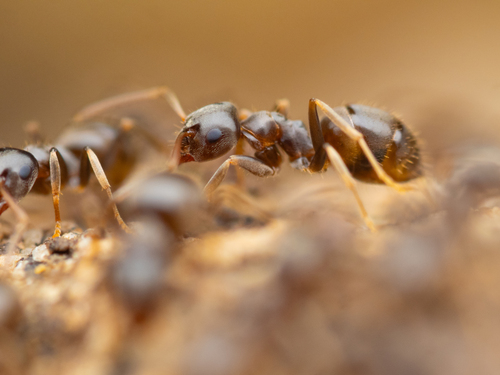
Cornfield Ant
Lasius alienus
The Cornfield Ant is the hidden architect of the meadow, a master aphid-farmer that builds complex empires right beneath your feet.
Quick Identification
Size
Workers: 2-4 mm (0.08-0.16 in); Queens: 7-9 mm (0.28-0.35 in); Males: 3-4 mm (0.12-0.16 in)
Colors
Light to dark brown body; uniform coloration with a slight glossy sheen and no distinct markings
Key Features
- Uniform brown coloration across the entire body
- Lack of standing hairs on the antennal scapes and hind tibiae
- Single-segmented waist (petiole) with a thin, upright scale
- Small size with workers rarely exceeding 4mm
When You’ll See Them
Geographic range
Where Does the Cornfield Ant Live?
Native to the temperate regions of the Northern Hemisphere, the Cornfield Ant is a ubiquitous presence throughout Europe and temperate Asia. While it is the quintessential 'brown ant' of the Old World, very similar and closely related species occupy the same niche across North America, from southern Canada through the central United States. It thrives in disturbed soils and open landscapes, making it one of the most common insects found in human-altered environments like parks and backyard gardens.
Basemap © OpenStreetMap contributors
Behavior
The Cornfield Ant is a highly social and industrious species that serves as a cornerstone of the backyard ecosystem. They are most famous for their symbiotic relationship with aphids and mealybugs, which they effectively 'farm.' The ants protect these sap-sucking insects from predators and, in return, harvest 'honeydew,' a sugary secretion that serves as a primary energy source for the colony. This behavior is so sophisticated that workers will often carry aphid eggs into their nests during winter to ensure a fresh supply of honeydew the following spring.
In the backyard, they are master excavators, creating sprawling underground galleries with small, crater-like entrances on the surface. While they are generally non-aggressive toward humans and lack a functional sting, they are highly territorial and will engage in fierce subterranean battles with rival ant colonies. Their social structure is led by a single queen (monogynous), and the colony communicates through complex chemical trails and tactile signals.
EverydayEarth exclusive
Camera Tips
Capturing the Cornfield Ant requires a specialized approach due to their diminutive size. To get clear footage, use a macro lens or a camera with a dedicated 'close-up' mode. Position your camera approximately 2 to 4 inches from the ground, focusing on a known nest entrance—look for small mounds of fine, granulated soil. A 45-degree downward angle is best for capturing the busy traffic of workers entering and exiting the colony.
To create a 'stage' for your camera, place a flat, dark stone near a nest and add a drop of sugar water or honey in the center. The dark background provides the necessary contrast to see the brown ants clearly, and the lure will attract dozens of workers at once, allowing you to observe their social interactions like trophallaxis (food sharing). For the best lighting, record during the golden hour in the late afternoon when the low sun highlights the glossy texture of their exoskeletons.
If your camera has adjustable trigger settings, set the sensitivity to high, as these ants may not have enough thermal mass to trigger standard PIR sensors. Using a time-lapse setting is often more effective than motion-triggering for insects. For a truly spectacular shot, keep your camera ready in late August after a rainstorm; this is when the winged queens and males emerge for their nuptial flights, creating a flurry of activity that is easily visible even on standard backyard cameras.
Similar Species
Species that look similar or are commonly confused with Cornfield Ant.
Frequently Asked Questions
Record Cornfield Ant at your habitat
Connect a camera to start building your own species record — AI identifies every visitor automatically.