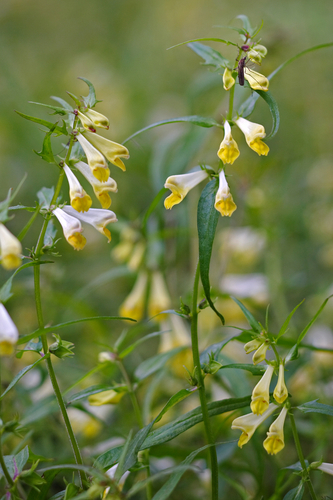
Common Cow-wheat
Melampyrum pratense
A subtle gem of the forest floor, Common Cow-wheat is a hemi-parasitic wonder that tricks ants into planting its seeds.
Quick Identification
Size
Height: 10–50 cm (4–20 inches); Flower length: 10–20 mm (0.4–0.8 inches)
Colors
Pale to deep yellow tubular flowers, often with white or cream tones; dark green or purplish-tinged lanceolate leaves
Key Features
- Pairs of tubular yellow flowers that all face one direction
- Narrow, lance-shaped leaves arranged in opposite pairs
- Purple-tinted bracts at the top of the stem
- Hemi-parasitic roots that attach to neighboring trees and grasses
When You’ll See Them
Behavior
Common Cow-wheat is a fascinating hemi-parasitic wildflower that plays a unique role in its ecosystem. While it possesses green leaves and can produce its own energy through photosynthesis, it also uses specialized root structures called haustoria to tap into the root systems of nearby plants. By siphoning water and minerals from hosts like oaks or grasses, it can thrive in the nutrient-poor, acidic soils of ancient woodlands and heathlands.
The plant has a specialized relationship with ants, a process known as myrmecochory. Its seeds feature a fleshy, nutrient-rich attachment called an elaiosome that mimics the scent of ant larvae. Ants are lured into carrying the seeds back to their nests, where they consume the fatty appendage and discard the seed in their waste chambers. This ensures the plant is 'planted' in a protected, nutrient-dense environment, often leading to localized clusters of the species near ant colonies.
EverydayEarth exclusive
Camera Tips
Capturing the Common Cow-wheat on a trail camera requires a shift from motion-triggering to time-lapse mode. Because the plant is stationary, set your camera to take an image every 15 to 30 minutes during daylight hours. This will allow you to document the 'sleep' movements of its leaves and the gradual opening of the tubular yellow flowers. Place your camera on a low-profile tripod or a ground mount, positioning the lens roughly 6 to 10 inches from the ground to capture the plant’s profile against the forest floor.
To capture the plant's unique 'behavior,' focus your lens on the base of the plant or the seed pods during late summer. This is when you are most likely to record ant activity. Ants are highly attracted to the elaiosomes on the seeds; by using a camera with a high-quality macro lens or a close-focusing distance, you can document the fascinating moment ants carry the seeds away. Ensure your camera is set to a high resolution (at least 12MP) to see these tiny interactions clearly.
Lighting is your biggest challenge in the woodland habitats where Cow-wheat thrives. The dappled sunlight of a forest canopy can create harsh highlights and deep shadows that blow out the delicate yellow of the flowers. Try to position your camera so the plant is back-lit or side-lit during the golden hours of 8-10 AM or 4-6 PM. If your camera has adjustable exposure settings, underexpose by one stop to preserve the detail in the bright yellow petals.
Because Common Cow-wheat is a hemi-parasite, it is often found in the company of specific host trees like Oak or Birch. When placing your camera, look for areas where the forest floor transitions into heathland. Using a 'field of view' that includes the surrounding mosses and leaf litter provides great context for the species. If you are using a triggered video mode, set the sensitivity to 'High' to try and catch the small bumblebees that are the primary pollinators, as they must physically force their way into the tubular flowers.
Similar Species
Species that look similar or are commonly confused with Common Cow-wheat.
Small Cow-wheat
Features much smaller, deep-yellow flowers (under 10mm) and prefers higher altitudes or more northerly latitudes.
Wood Cow-wheat
Also known as Melampyrum nemorosum, it is distinguished by its strikingly bright blue or purple upper bracts.
Yellow Rattle
A fellow hemi-parasite with flatter, more rounded yellow flowers and distinctive 'rattling' seed pods.
Frequently Asked Questions
Record Common Cow-wheat at your habitat
Connect a camera to start building your own species record — AI identifies every visitor automatically.