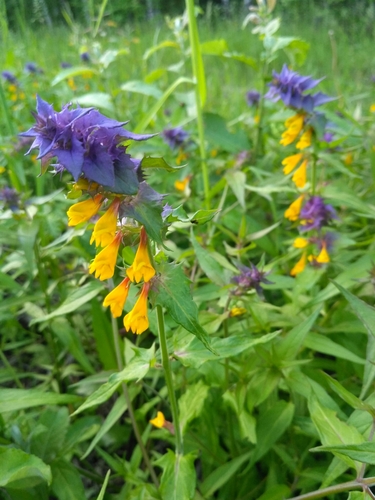
Wood Cow-wheat
Melampyrum nemorosum
Known in Sweden as 'Night and Day,' this striking forest wildflower captivates with its brilliant purple bracts and golden yellow blooms. A master of the forest edge, it leads a double life as a beautiful bloom and a clever root parasite.
Quick Identification
Size
Stands approximately 10 to 50 cm (4 to 20 inches) tall with a slender, upright growth habit.
Colors
Striking contrast of vivid purple or deep blue upper bracts and bright yellow tubular flowers; foliage is typically deep green.
Key Features
- Electric purple or violet-blue upper bracts that look like leaves
- Bright yellow tubular flowers tucked beneath the purple bracts
- Opposite, lance-shaped green leaves with pointed tips
- Hemi-parasitic root system that connects to neighboring plants
When You’ll See Them
Behavior
Wood Cow-wheat is a fascinating annual wildflower known for its hemi-parasitic lifestyle. While it possesses green leaves and can perform photosynthesis to create its own energy, it also develops specialized root structures called haustoria. These allow the plant to tap into the root systems of neighboring trees and grasses, siphoning off water and mineral nutrients to fuel its rapid seasonal growth. This strategy makes it highly successful in the competitive environment of forest floors and edges.
The plant is famous for its 'Night and Day' appearance, a name derived from the stark contrast between the sun-yellow flowers and the dark, moody purple bracts that sit above them. In many European cultures, this duality has led to rich folklore, symbolizing balance or legendary pairs of lovers. It is a vital member of its ecosystem, primarily pollinated by bumblebees who are strong enough to push into its hooded flowers to reach the nectar reward hidden deep within.
EverydayEarth exclusive
Camera Tips
Capturing the Wood Cow-wheat requires a different approach than fast-moving wildlife. To truly highlight its 'Night and Day' colors, set your camera at a low 'worm's-eye' view. This perspective emphasizes the height of the bracts against the forest floor and allows you to capture the intricate details of the yellow flowers peeking out from underneath. Use a tripod or a stable ground mount to ensure your macro shots are crisp, as the subtle movements of the plant in a light breeze can cause motion blur.
Because this species thrives in forest edges, lighting can be challenging. The high contrast between the purple bracts and yellow flowers often leads to overexposed highlights or muddy shadows in direct sunlight. Aim to photograph or set your AI camera triggers for 'golden hour'—shortly after sunrise or before sunset—when the light is soft and directional. This timing brings out the velvety texture of the purple leaves. If your camera allows for time-lapse, Wood Cow-wheat is an excellent subject; a 24-hour cycle can show the plant nodding slightly and the flowers opening to greet bumblebees.
If you are using an EverydayEarth AI camera to monitor biodiversity, place the unit near a cluster of Wood Cow-wheat and focus on the floral openings. This species is a magnet for large bumblebees. By setting a high-speed shutter or a short video trigger, you can capture the specific pollination behavior where bees must force their way into the flower. Avoid using heavy baits or lures near the plant, as you want to preserve the natural soil chemistry that the cow-wheat’s parasitic roots rely on. Instead, ensure the area around the plant is clear of tall, distracting grass blades that might trigger the camera unnecessarily on windy days.
Similar Species
Species that look similar or are commonly confused with Wood Cow-wheat.
Frequently Asked Questions
Record Wood Cow-wheat at your habitat
Connect a camera to start building your own species record — AI identifies every visitor automatically.