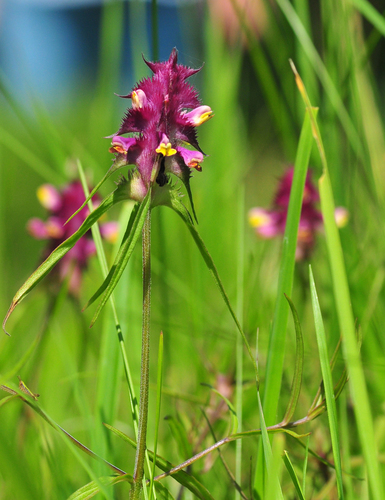
Crested Cow-wheat
Melampyrum cristatum
A botanical jewel of the woodland edge, Crested Cow-wheat stands out with its intricate, comb-like purple bracts and unique parasitic lifestyle.
Quick Identification
Size
Height ranges from 15 to 50 cm (6 to 20 inches), with flower spikes roughly 3-5 cm long.
Colors
Pale yellow flowers tucked behind striking pinkish-purple or deep magenta bracts; green lanceolate leaves.
Key Features
- Dense four-sided flower spike
- Pink-purple comb-like (pectinate) bracts
- Opposite lance-shaped leaves
- Square stem typical of the order
When You’ll See Them
Geographic range
Where Does the Crested Cow-wheat Live?
Crested Cow-wheat is native across the temperate regions of Europe and Western Asia. Its core range extends from the British Isles—where it is increasingly rare—throughout Central and Northern Europe, reaching as far east as the Ural Mountains in Russia. It is typically found in pockets of undisturbed habitat where traditional land management allows its host plants to flourish.
Basemap © OpenStreetMap contributors
Behavior
Crested Cow-wheat is a fascinating hemiparasitic plant, meaning that while it has green leaves for photosynthesis, it also relies on the root systems of neighboring plants to survive. By attaching itself to the roots of grasses and shrubs via specialized organs called haustoria, it siphons off water and mineral nutrients, making it a subtle but effective opportunist in the meadow ecosystem.
Its flowering strategy is highly specialized for bumblebees. The structure of the flower requires a strong insect to force its way inside to reach the nectar, ensuring that only efficient pollinators visit. This interaction makes the plant a hub of activity during the summer months, as it competes with other wildflowers for the attention of local bee colonies.
EverydayEarth exclusive
Camera Tips
Capturing the beauty of Crested Cow-wheat requires a different strategy than tracking mobile wildlife. To get the best results, use a camera with a high-quality macro lens or a 'Macro' setting on your trail camera. Position your device on a low-profile tripod or a ground mount, roughly 12 to 18 inches away from the flower spike. Aim for a slightly upward angle to emphasize the 'crested' appearance of the colorful bracts against the sky or woodland canopy.
For truly professional results, utilize a time-lapse feature. Set your camera to take a photo every 15 to 30 minutes over a period of several days. This allows you to witness the 'unfolding' of the flower spike and the subtle movements of the plant as it tracks the sun. Ensure your camera is secured firmly, as even slight wind can cause significant blur in macro shots; a small windscreen or placing the camera in a sheltered forest edge can help mitigate this.
If you are using an AI-powered camera like those featured on EverydayEarth, focus on 'Pollinator Watching.' Set your camera to trigger on motion during the peak daylight hours of 10 AM to 3 PM. You will likely capture a variety of bumblebee species (Bombus spp.) visiting the flowers. These cameras can help you document which specific insects are helping your local population of Crested Cow-wheat reproduce, providing valuable citizen science data.
Similar Species
Species that look similar or are commonly confused with Crested Cow-wheat.
Frequently Asked Questions
Record Crested Cow-wheat at your habitat
Connect a camera to start building your own species record — AI identifies every visitor automatically.