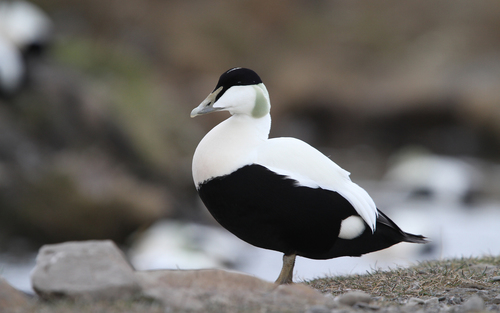
Common Eider
Somateria mollissima
The Common Eider is the heavy-duty mariner of the bird world, famous for its incredibly warm down and its ability to withstand the harshest North Atlantic winters.
Quick Identification
Size
Length: 50–71 cm (20–28 in); Wingspan: 80–110 cm (31–43 in); Weight: 1.2–3 kg (2.6–6.6 lbs)
Colors
Males are starkly white above and black below with a greenish nape; females are camouflaged in mottled rusty-brown and black.
Key Features
- Massive wedge-shaped bill that slopes directly into the forehead
- Distinctive 'sailing' profile when floating
- Males feature a black crown and pale green patch on the neck
- Dense, puffy appearance due to thick down feathers
When You’ll See Them
Geographic range
Where Does the Common Eider Live?
Native to the northernmost reaches of the Northern Hemisphere, the Common Eider thrives along the Arctic and subarctic coastlines of North America, Europe, and eastern Siberia. In North America, its core range extends from the Canadian Arctic down to New England and the Pacific Northwest, while European populations are concentrated around the British Isles, Scandinavia, and Iceland. These ducks are strictly coastal, rarely venturing far inland, and will migrate only as far south as necessary to find ice-free water in the winter.
Basemap © OpenStreetMap contributors
Behavior
Common Eiders are highly social sea ducks, often found in massive rafts that can number in the thousands, especially during the winter months. They are powerful divers, capable of reaching depths of over 20 meters to forage on the ocean floor. Unlike many other ducks, they are remarkably heavy and rely on a 'runway' start across the water's surface to achieve flight, but once airborne, they are incredibly fast, reaching speeds up to 70 mph.
During the breeding season, they form dense colonies on offshore islands to protect themselves from land predators. They have a fascinating relationship with humans; for centuries, coastal communities have 'farmed' eiderdown by collecting the soft breast feathers the females use to line their nests, often providing nesting boxes or protection in exchange. They are generally wary of people but can become accustomed to human presence in busy harbor areas.
EverydayEarth exclusive
Camera Tips
Capturing the Common Eider on a backyard or shoreline camera requires a strategy focused on the tide. If you live on a coastal property, place your camera on a weighted tripod or a low-profile rock mount just above the high-tide line. Angle the camera slightly downward toward the water's edge or a known 'haul-out' rock where ducks might rest during mid-tide. Because eiders are low-slung, a camera height of 12-18 inches is ideal for eye-level portraits.
Since these are sea ducks, salt spray and humidity are your biggest enemies. Use a high-quality waterproof housing and consider applying a hydrophobic coating (like Rain-X) to the lens cover to prevent water spots from ruining your shots. Given the bright white plumage of the males against dark coastal rocks, set your exposure compensation to -0.5 or -1.0 to avoid blowing out the highlights in midday sun.
To attract them into frame, focus on areas with natural mussel beds or barnacle-covered rocks rather than using artificial bait, which is often ineffective and can be messy in a marine environment. The best time for activity is during the rising tide when the ducks move closer to shore to feed on newly submerged invertebrates. Set your camera to a high-speed burst mode or 'Photo + Video' setting, as their diving and surfacing transitions happen quickly and make for spectacular footage.
Similar Species
Species that look similar or are commonly confused with Common Eider.
King Eider
Smaller with a more rounded head profile and an orange forehead plate on the male.
White-winged Scoter
Darker overall plumage and lacks the distinct white back and green nape of the male eider.
Mallard
Females are similar in color, but eiders are much larger, heavier, and have a unique wedge-shaped bill.
Frequently Asked Questions
Record Common Eider at your habitat
Connect a camera to start building your own species record — AI identifies every visitor automatically.