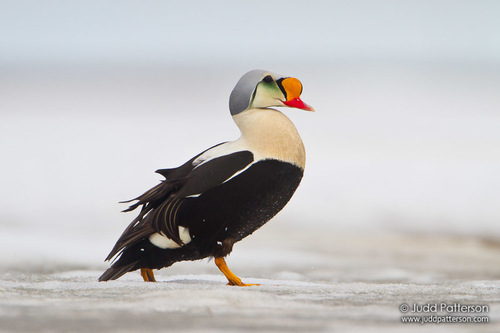
King Eider
Somateria spectabilis
The King Eider is the regal jewel of the Arctic, sporting a multi-colored crown and a stoic personality. This deep-diving sea duck thrives in the world's coldest waters, making it one of the most sought-after sightings for northern wildlife photographers.
Quick Identification
Size
Length 47–63 cm (18.5–24.8 in), wingspan 86–102 cm (33.9–40.2 in), weight 1.2–2.1 kg (2.6–4.6 lb)
Colors
Males have a pale blue crown, sea-foam green cheeks, a bright orange bill shield, and a black body with a white chest. Females are mottled cinnamon-brown.
Key Features
- Large orange-yellow frontal shield on the male's forehead
- Powder-blue crown and nape on breeding males
- Distinctive 'smiling' gape line on the bill
- V-shaped black marking on the throat of males
When You’ll See Them
Geographic range
Where Does the King Eider Live?
The King Eider is a true circumpolar resident of the far north, native to the Arctic regions of North America, Europe, and Asia. Its core breeding range spans the northernmost reaches of Alaska, the Canadian Arctic islands, Greenland, and the Siberian coastline. During the winter months, these resilient ducks migrate just far enough south to find ice-free water, commonly appearing along the coasts of the Aleutian Islands, the Atlantic provinces of Canada, and occasionally the northeastern United States and Scandinavia.
Basemap © OpenStreetMap contributors
Behavior
King Eiders are powerful, deep-diving sea ducks that spend the majority of their lives in the open ocean. They are incredibly hardy, often staying as far north as open water persists throughout the winter. When foraging, they can dive to impressive depths of over 50 meters to reach the sea floor, where they hunt for benthic invertebrates. Unlike many other ducks, they are highly social outside of the breeding season, forming massive flocks that can number in the thousands during migration.
During the brief Arctic summer, King Eiders move inland to the tundra to breed. The males are known for their elaborate courtship displays, which include rhythmic head-tossing and soft, 'cooing' vocalizations. Once the female begins incubating the eggs, the males depart, migrating back to coastal 'moulting' areas. These birds are generally wary of humans, and because their breeding grounds are so remote, they are rarely encountered in suburban environments except as rare winter visitors to coastal piers.
EverydayEarth exclusive
Camera Tips
Capturing a King Eider on a trail camera requires targeting their very specific seasonal habitats. During the summer breeding window on the Arctic tundra, place your camera near the edges of small freshwater ponds or lakes. These birds prefer nesting in low-lying grassy areas, so a ground-level camera mount is essential. Position the camera about 6-12 inches off the ground to get an eye-level perspective as they walk to and from the water.
In winter, you will need a camera setup capable of withstanding harsh coastal conditions. Focus on rocky points, breakwaters, or piers where the ducks may come closer to shore to feed during high tide. Use a camera with a fast trigger speed and high-speed burst mode, as sea ducks move quickly in the surf. Because the winter light is often flat and gray, ensure your camera has a high-quality sensor that performs well in low-light conditions without introducing too much noise.
While baiting is not standard for sea ducks, placing a camera near a natural congregation of blue mussels or other shellfish at low tide can increase your chances of a sighting. Always use a waterproof, salt-resistant housing if you are near the ocean, as salt spray can damage electronics and cloud the lens within hours. Regularly cleaning the lens with a microfiber cloth and fresh water is the best way to ensure crisp, clear images of these royal ducks.
Similar Species
Species that look similar or are commonly confused with King Eider.
Common Eider
Common Eiders are larger with a long, sloping wedge-shaped profile to the bill, lacking the King's bulbous orange shield.
Spectacled Eider
Spectacled Eiders have distinctive white 'goggles' around the eyes, which are absent in King Eiders.
Steller's Eider
Much smaller in size with a square-shaped head and a distinct black collar on the male.
Frequently Asked Questions
Record King Eider at your habitat
Connect a camera to start building your own species record — AI identifies every visitor automatically.