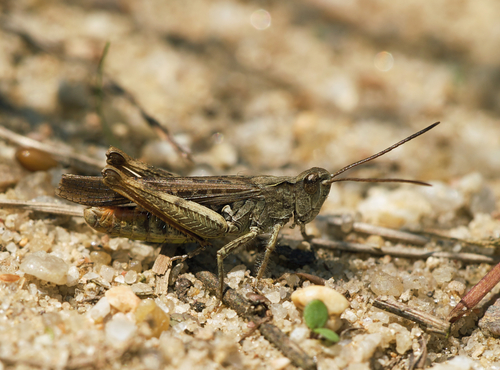
Common Field Grasshopper
Chorthippus brunneus
The Common Field Grasshopper is the quintessential sound of summer. This master of camouflage is famous for its rhythmic chirping and its ability to leap twenty times its own body length in an instant.
Quick Identification
Size
Males 14–18 mm (0.55–0.71 in); Females 18–25 mm (0.7–1 in)
Colors
Variable; usually brown or grey, but occasionally green, purple, or mottled. Males often have an orange-red tip to the abdomen.
Key Features
- Indented 'keels' (carinae) on the pronotum forming a sharp wedge shape
- Hairy underside of the thorax (chest area)
- Wings extend significantly past the end of the abdomen
- Loud, short chirps lasting about 0.5 seconds
When You’ll See Them
Geographic range
Where Does the Common Field Grasshopper Live?
This species is a widespread native of the Western Palearctic, stretching across almost the entirety of Europe and Northern Africa into temperate parts of Asia. It is one of the most frequently encountered grasshoppers in the United Kingdom, Scandinavia, and Western Europe, where it thrives in both rural and suburban environments. While it is not found in the Americas, its ability to adapt to human-altered landscapes makes it a dominant species across the Eurasian continent.
Basemap © OpenStreetMap contributors
Behavior
During the day, males spend much of their time 'stridulating'—the process of rubbing their hind legs against their wings to create a rhythmic song to attract females. They are extremely sensitive to movement and shadows; at the first sign of a predator (or a photographer), they will launch themselves several feet into the air, often using their wings to glide even further away.
As adults, they are solitary but can appear in high concentrations where habitat conditions are ideal. They are harmless to humans and are an essential part of the food web, serving as a vital protein source for many birds and small mammals during the late summer months.
EverydayEarth exclusive
Camera Tips
To capture high-quality images of a Common Field Grasshopper, you need to focus on 'hot spots.' These grasshoppers are ectothermic and love to bask. Place your camera near a flat, dark stone or a patch of bare, dry earth surrounded by short grass. These are the stages where they perform their songs and soak up the sun. Because they are small, a macro lens or a camera with a close-focusing distance (within 10-20cm) is vital for a clear shot.
Placement is everything. Set your camera at a very low angle—ground level is best—to capture the insect's profile against the sky or distant greenery, which creates a professional 'bokeh' effect. Use a high shutter speed if possible, as these insects can vanish in a fraction of a second. If you are using an AI-triggered camera, ensure the sensitivity is set to high, as the small size of the grasshopper may not trigger standard motion sensors designed for larger mammals.
The best time for photography is mid-morning. During this time, the grasshoppers are warming up and are slightly less flighty than in the scorching heat of the afternoon. If you can, record video clips; the sight of a male vigorously rubbing his hind legs against his wings is one of the most iconic behaviors of the species and makes for fantastic social media content. Avoid using heavy baits; instead, just ensure the grass in front of your camera is kept short so the subject isn't obscured by blades of grass.
Similar Species
Species that look similar or are commonly confused with Common Field Grasshopper.
Meadow Grasshopper
The Meadow Grasshopper has wings that do not reach the end of the abdomen in females and lacks the hairy underside on the thorax.
Bow-winged Grasshopper
Almost identical visually, but the male's song is a much longer, slow-building vibration rather than short chirps.
Mottled Grasshopper
Has distinctive club-tipped antennae, which the Common Field Grasshopper lacks.
Frequently Asked Questions
Record Common Field Grasshopper at your habitat
Connect a camera to start building your own species record — AI identifies every visitor automatically.