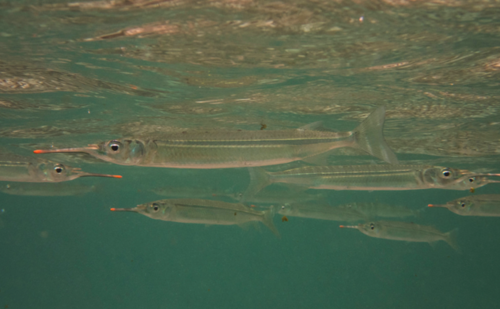
Common Halfbeak
Hyporhamphus unifasciatus
A master of the ocean's surface, the Common Halfbeak is easily identified by its needle-like lower jaw and shimmering silver stripe. These agile swimmers are a vital part of Atlantic coastal ecosystems, often seen skipping across the waves to evade predators.
Quick Identification
Size
Typically 15-25 cm (6-10 inches), reaching a maximum length of about 30 cm (12 inches)
Colors
Silvery-white underside and flanks with a prominent silver lateral stripe; back is typically a translucent greenish or olive-blue. The tip of the long lower jaw often features a bright orange or red fleshy point.
Key Features
- Extremely elongated lower jaw with a short upper jaw
- Brilliant silver stripe running horizontally along the side
- Dorsal and anal fins positioned far back near the tail
- Slender, streamlined, and slightly compressed body shape
When You’ll See Them
Geographic range
Where Does the Common Halfbeak Live?
Native to the subtropical and tropical reaches of the Western Atlantic Ocean, the Common Halfbeak’s territory stretches from the coastal waters of southern New England down through the Gulf of Mexico and the Caribbean to southern Brazil. They are a quintessential sight in the shallow, sun-drenched coastal regions of the United States, particularly along the Florida coastline and the Florida Keys. These fish are lowland coastal specialists, thriving in the interconnected network of bays, estuaries, and salt marshes that define the American southeast and Central American shorelines.
Basemap © OpenStreetMap contributors
Behavior
The Common Halfbeak is a surface-dwelling specialist, often found in large, shimmering schools just below the water's interface. They are agile swimmers, using their streamlined bodies to dart quickly away from predators. Because they live at the very top of the water column, they have evolved to be nearly invisible from below due to their silvery bellies (countershading) and difficult to see from above against the moving water.
These fish are known for their unique 'skipping' behavior. When threatened by larger predatory fish like jacks or barracuda, halfbeaks will leap from the water and vibrate their tails against the surface to propel themselves forward in a series of rapid jumps. While they are not a primary food source for humans, they are a vital link in the coastal food web, serving as a staple prey item for many seabirds and larger game fish.
EverydayEarth exclusive
Camera Tips
Capturing Common Halfbeaks on camera requires a specialized approach because they reside almost exclusively in the top few inches of the water column. For waterfront 'backyard' observers with a dock or pier, the best setup is a waterproof action camera or an AI-powered underwater housing mounted just 6 to 12 inches below the surface. Point the lens horizontally or slightly upward toward the sky to capture their distinctive silhouettes and the bright silver flash of their flanks as they pass through the sunlight.
Natural lighting is your best friend with this species. Aim your camera toward the sun (but not directly into it) during the mid-morning or late afternoon to catch the 'glitter' effect of their scales. If you are using a camera from above the water (on a pier or seawall), a circular polarizing filter is essential to cut through the surface glare and reveal the fish beneath. AI motion detection can be tricky with surface ripples, so high-sensitivity settings or 'constant recording' with post-processing AI is recommended.
To attract a school into your camera's field of view, consider using a small amount of floating fish food or finely chopped shrimp. Since they are surface feeders, the bait must stay afloat. Halfbeaks are naturally curious about floating debris and will often congregate around shadows. Setting your camera near a floating dock or under the shade of an overhanging mangrove branch can significantly increase your chances of a close-up encounter. During the summer months, keep an eye out for calm, 'glassy' water days, which provide the best clarity for underwater photography.
Similar Species
Species that look similar or are commonly confused with Common Halfbeak.
Ballyhoo
Larger with distinct orange-red tips on the lobes of the tail fin.
Longfin Halfbeak
Has significantly longer pectoral fins and prefers more open, oceanic waters.
Atlantic Needlefish
Both the upper and lower jaws are elongated into a sharp beak, whereas the halfbeak only has an elongated lower jaw.
Frequently Asked Questions
Record Common Halfbeak at your habitat
Connect a camera to start building your own species record — AI identifies every visitor automatically.