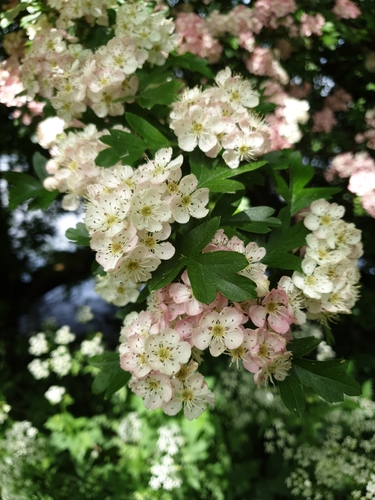
common hawthorn
Crataegus monogyna
Often called the 'May-tree,' the common hawthorn is a thorny sanctuary that brings the drama of the wild right into your backyard. From its sweet spring blossoms to its winter bounty of red berries, it is a year-round magnet for birds and beneficial insects.
Quick Identification
Size
5-15 meters (16-49 feet) in height with a spread of 4-8 meters (13-26 feet)
Colors
Creamy white flowers with pink-tipped stamens; dark glossy green leaves; bright ruby-red berries (haws); grey-brown bark with orange-brown fissures
Key Features
- Leaves deeply lobed more than halfway to the midrib
- Sharp woody thorns up to 12mm long
- Clusters of white 5-petaled flowers in May
- Single-seeded red berries in autumn
When You’ll See Them
Loading activity data...
Behavior
The common hawthorn is a foundational species in many ecosystems, often referred to as a "living fence." It is a hardy, deciduous tree known for its dense, twiggy growth habit that provides nearly impenetrable cover for nesting birds and small mammals. In the spring, it undergoes a dramatic transformation, becoming smothered in a frothy layer of white blossoms that emit a powerful, sweet, and slightly musky scent designed to attract a wide array of pollinating insects.
As the year progresses, the hawthorn serves as a critical food source. By late summer and autumn, the flowers develop into deep red berries called "haws." These are a vital energy source for migratory birds like Redwings and Fieldfares. In the garden, a hawthorn tree acts as a central hub, attracting wildlife from the surrounding area and providing a safe corridor for animals to move between habitats without being exposed to predators.
EverydayEarth exclusive
Camera Tips
To capture the best footage of wildlife interacting with a common hawthorn, focus your camera on the "activity zones" rather than the whole tree. During the spring, aim your camera at a specific cluster of blossoms at eye level. This is where you will see the highest concentration of pollinators, including bees, hoverflies, and even some species of butterflies. Use a high-speed video setting if your camera allows, as the movement of these insects can be very rapid.
In the autumn and winter, the red berries are the star attraction. Mount your camera on a nearby post or a sturdy branch facing a berry-rich section of the tree. This is the perfect time to capture birds like blackbirds, thrushes, and robins. Because these birds are often wary, place your camera at least 5 to 10 feet away to avoid spooking them, and use a narrow-angle lens if possible to get a tight shot of the feeding action.
Don't forget the base of the tree! The thorny interior of the hawthorn makes it a preferred shelter for ground-dwelling animals like hedgehogs and wood mice. Positioning a camera low to the ground near the trunk can reveal a whole world of nocturnal activity as animals scavenge for fallen berries or seek protection from predators. Use a trail camera with high-quality IR (infrared) night vision for these shots.
One technical challenge with hawthorns is the movement of their thin, flexible branches in the wind, which can lead to hundreds of false triggers on motion-sensing cameras. To mitigate this, try to mount your camera on a solid, non-moving structure and use the "zone masking" feature on your AI camera to ignore the areas where the most branch movement occurs, focusing the trigger area only on the most stable parts of the tree or the ground below.
Similar Species
Species that look similar or are commonly confused with common hawthorn.
Midland Hawthorn
Midland hawthorn has leaves that are less deeply lobed and berries that typically contain two stones instead of one.
Blackthorn
Blackthorn flowers earlier in the spring (usually March) before its leaves appear, whereas Hawthorn flowers after the leaves have opened.
Rowan
Rowan has pinnate leaves (multiple leaflets on one stem) and much larger, denser clusters of smaller orange-red berries.
Frequently Asked Questions
Record common hawthorn at your habitat
Connect a camera to start building your own species record — AI identifies every visitor automatically.