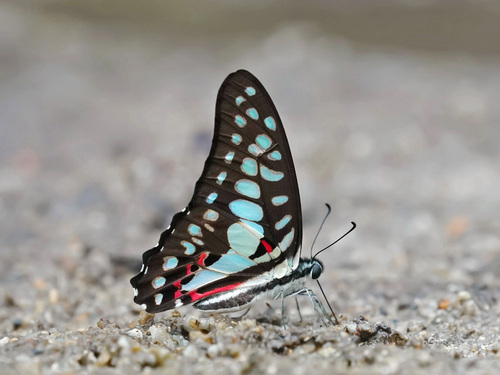
Common Jay
Graphium doson
A restless traveler of the Asian tropics, the Common Jay dazzles with its semi-transparent blue wings and lightning-fast flight. It is a frequent and welcome visitor to any garden filled with nectar-rich blooms.
Quick Identification
Size
Wingspan of 70-80 mm (2.75-3.15 inches)
Colors
Velvety black base with central bands of pale blue semi-transparent spots. Underside is chocolate brown with whitish-blue markings and small red spots near the wing base.
Key Features
- Pale blue semi-transparent central wing bands
- Marginal series of smaller pale blue spots
- Underside features distinct red spots near the body
- Rapid, erratic zigzagging flight pattern
When You’ll See Them
Geographic range
Where Does the Common Jay Live?
The Common Jay is a quintessential inhabitant of the Asian tropics and subtropics. Its vast native range begins in the Indian subcontinent and Sri Lanka, stretching eastward through Myanmar, Thailand, and the Malay Peninsula into Indonesia. It also reaches northward into southern China and as far as the southern islands of Japan, where it is a common sight in both wild woodlands and developed urban green spaces.
Basemap © OpenStreetMap contributors
Behavior
The Common Jay is an exceptionally energetic butterfly, known for its restless nature and high-speed flight. Unlike many other swallowtails that glide gracefully, the Common Jay darts frantically between nectar sources, rarely resting for more than a few seconds. It is a sun-loving species that remains most active during the peak heat of the day, patrolling garden borders and forest edges for available blooms.
One of the most fascinating social behaviors of the Common Jay is 'mud-puddling.' Males often congregate in large groups on damp soil, riverbanks, or even moist gravel to extract essential salts and minerals from the water. In the backyard setting, they are solitary visitors to flowers but can become quite bold, frequently returning to the same nectar-rich bushes day after day.
EverydayEarth exclusive
Camera Tips
To capture the high-speed Common Jay on a backyard camera, placement is everything. These butterflies are drawn to bright, nectar-rich flowers like Ixora, Lantana, and Buddleia. Position your camera approximately 2 to 3 feet away from these blooms, angled slightly upward to catch the sun hitting their semi-transparent blue wing spots. Because they move so quickly, use the fastest shutter speed your camera allows or a 'burst' mode to ensure you don't just get a blue blur.
A unique way to lure Common Jays into a stable position for the camera is to create a 'mud-puddling' station. Mix sand with a small amount of sea salt or compost tea, and keep it consistently damp in a sunny spot on the ground. Place your camera on a low tripod or ground mount just 10-15 inches away from this patch. Males will often land and remain relatively still while they drink, offering a rare opportunity to capture the intricate red and silver markings on their undersides.
If you are monitoring for breeding activity, target host trees such as the Mast Tree (Polyalthia longifolia). Set your camera to focus on the fresh, lime-green young shoots where females prefer to lay their eggs. Since these butterflies are most active during peak sunlight, ensure your camera has good high-dynamic-range (HDR) capabilities to prevent the bright blue spots from 'blowing out' in the midday glare.
Similar Species
Species that look similar or are commonly confused with Common Jay.
Frequently Asked Questions
Record Common Jay at your habitat
Connect a camera to start building your own species record — AI identifies every visitor automatically.