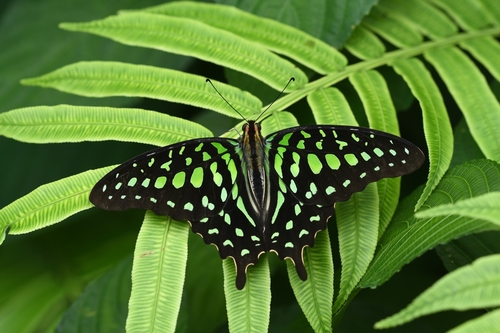
Tailed Jay
Graphium agamemnon
With its striking electric-green spots and swift, shivering flight, the Tailed Jay is a jewel of the tropical garden. This restless swallowtail is a master of movement, bringing a dash of neon color to backyard observers across Asia and Australia.
Quick Identification
Size
Wingspan of 85–100 mm (3.3–3.9 inches); body length approx 25–30 mm (1 inch)
Colors
Velvet-black to dark brownish wings covered in vibrant apple-green spots and streaks; underside is a lighter violet-brown with green and pinkish-red base spots.
Key Features
- Distinctive lime-green spots on a black background
- Short, pointed tails on the hindwings
- Restless wing-vibration during feeding
- Elegant, triangular wing shape
When You’ll See Them
Geographic range
Where Does the Tailed Jay Live?
The Tailed Jay is native to the tropical and subtropical regions of Asia and Oceania. Its core range spans from the Indian subcontinent, including India and Sri Lanka, eastward through Southeast Asia to the Philippines and Indonesia, and as far south as northern Australia. It is a highly adaptable species that thrives in both wild forest environments and densely populated urban centers throughout its range.
Basemap © OpenStreetMap contributors
Behavior
The Tailed Jay is an exceptionally energetic and restless butterfly. Unlike many other species that come to a complete standstill when feeding, the Tailed Jay is famous for its 'shivering' flight—it keeps its wings vibrating rapidly even while it probes flowers for nectar. This constant motion makes it a high-energy visitor to any garden, moving sporadically from one bloom to the next in a swift, erratic flight pattern.
These butterflies are mostly solitary, though you may see several in a single garden if host plants are nearby. Males are occasionally observed 'puddling' on damp soil to absorb essential minerals, but they spend most of their time patrolling for mates or food. They are generally bold and well-adapted to human presence, often flying quite close to observers in pursuit of nectar.
EverydayEarth exclusive
Camera Tips
To capture a Tailed Jay on a backyard camera, your primary focus should be on their favorite nectar sources. Plants with clusters of small, bright flowers like Lantana or Ixora are magnets for this species. Place your camera on a tripod at a height of approximately 3 to 4 feet, angling it slightly downward to capture the full spread of the wings when they land. Because they are so fast, use a high shutter speed or 'burst mode' if your camera supports it to avoid motion blur.
Sunlight is your best friend when filming butterflies. Position your camera in a spot that receives full morning sun (between 9 AM and 11 AM), as this is when the Tailed Jay is most active but slightly less frantic than in the midday heat. The bright light will also help the AI sensors pick up the high-contrast green spots against the black wing background, which is essential for accurate identification.
If you want to encourage the Tailed Jay to pause for a longer duration, consider planting its larval host plants, such as the Polyalthia longifolia (Ashoka tree). Females will linger near these trees to deposit eggs on the undersides of young leaves. For a unique shot, you can also set up a 'puddling' station by keeping a small patch of soil or sand damp with a very diluted salt solution; males may land here to drink, offering a rare chance to capture them with their wings held still.
Similar Species
Species that look similar or are commonly confused with Tailed Jay.
Frequently Asked Questions
Record Tailed Jay at your habitat
Connect a camera to start building your own species record — AI identifies every visitor automatically.