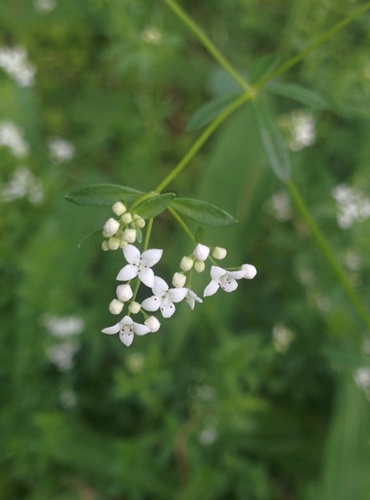
Common Marsh-bedstraw
Galium palustre
A delicate, white-flowered resident of the water's edge, Common Marsh-bedstraw is a master of the dampest corners of the backyard. Its slender, scrambling stems and star-like blooms provide a vital stage for tiny pollinators in wetland habitats.
Quick Identification
Size
Height ranges from 10–60 cm (4–24 inches); stems are slender and weak, often scrambling over other plants.
Colors
Small white flowers with four petals; bright green leaves that turn black when dried.
Key Features
- Leaves arranged in whorls of 4 (rarely up to 6)
- Slender, square-shaped stems with few if any prickles
- Tiny white flowers (2-3mm) in loose clusters
- Found exclusively in wet or boggy soil
When You’ll See Them
Geographic range
Where Does the Common Marsh-bedstraw Live?
Native across the vast expanse of Europe and northern Africa, the Common Marsh-bedstraw has successfully bridged the Atlantic to establish a significant presence in eastern North America. You can find it stretching from the rocky coasts of Greenland down through the wetlands of New England and eastern Canada, where it often forms dense, thriving mats in saturated soils. While it is a cherished native in many parts of the Old World, it has also found its way to the Southern Hemisphere, becoming naturalized in the temperate regions of Australia and New Zealand.
Basemap © OpenStreetMap contributors
Behavior
Common Marsh-bedstraw is a low-growing, scrambling perennial (sometimes annual depending on local climate) that thrives in the saturated soils of wetland ecosystems. Unlike its cousin, the sticky 'Cleavers,' this species has relatively smooth stems and relies on surrounding vegetation for structural support, often forming tangled, airy mats near the water's edge. It grows rapidly during the late spring, reaching its peak flowering period in mid-summer when it becomes a hub for small pollinators.
While it doesn't 'behave' in an animal sense, it is a master of niche competition in damp environments. It utilizes a sprawling growth habit to maximize sunlight capture in crowded marshlands. In parts of North America where it has been introduced, it can be quite aggressive, outcompeting local flora and earning it a 'noxious weed' status in several northeastern U.S. states. However, in its native range, it is an essential part of the riparian landscape, providing micro-habitats for aquatic insects and small amphibians.
EverydayEarth exclusive
Camera Tips
Capturing the Common Marsh-bedstraw requires a focus on macro photography and time-lapse settings. Because this plant lives in wet areas, ensure your camera housing is waterproof and mounted on a stable, rust-proof stake. Position the camera low to the ground, about 6–12 inches high, to capture the intricate whorls of leaves and the delicate structure of the flower clusters. Angle the lens slightly upward to catch the sunlight filtering through the white petals, which can create a beautiful translucent effect.
To capture 'action,' set your AI camera to trigger on small movements. While the plant itself only moves with the wind, it is a frequent landing pad for hoverflies, small bees, and butterflies. Using a time-lapse mode—taking a photo every 15–30 minutes—is the best way to document its rapid growth and the 'scrambling' behavior as it climbs over neighboring reeds and grasses during the spring and summer months.
Lighting is your biggest challenge. The tiny white flowers can easily 'blow out' and lose detail in direct midday sun. If possible, place your camera in a spot that receives dappled light or use a small diffuser. Early morning is the best time for photography, as dew drops often cling to the slender stems and leaves, creating stunning, high-contrast images that highlight the plant's delicate geometry against the darker marsh background.
Similar Species
Species that look similar or are commonly confused with Common Marsh-bedstraw.
Frequently Asked Questions
Record Common Marsh-bedstraw at your habitat
Connect a camera to start building your own species record — AI identifies every visitor automatically.