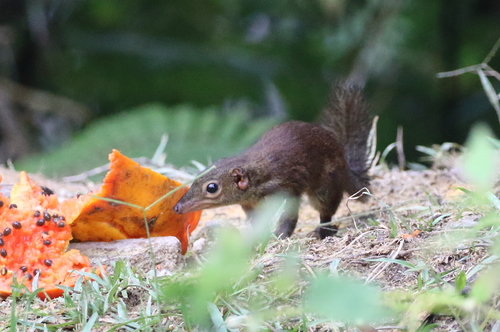
Common Treeshrew
Tupaia glis
Meet the Common Treeshrew, a high-speed, long-snouted marvel of the Southeast Asian undergrowth. Neither a shrew nor a squirrel, this diurnal primate-relative brings a burst of energy to tropical backyards.
Quick Identification
Size
Head-body length of 16–21 cm (6.3–8.3 in); tail length 12–20 cm (4.7–7.9 in); weight averages 140–200 g (4.9–7.1 oz).
Colors
Upperparts are reddish-brown, olive, or greyish-brown; underparts are pale buff or orange-white; a distinct pale diagonal stripe is visible on each shoulder.
Key Features
- Long, pointed snout with sensitive whiskers
- Bushy, squirrel-like tail
- Pale, thin diagonal stripe on each shoulder
- Large, dark eyes set high on the head
When You’ll See Them
Geographic range
Where Does the Common Treeshrew Live?
The Common Treeshrew is a native icon of Southeast Asia, thriving across a broad equatorial band. Its core population resides in Southern Thailand, Peninsular Malaysia, and Singapore, extending across the major Indonesian islands of Sumatra, Java, and Borneo. Because it adapts well to human-altered landscapes, it is also frequently found in the rural gardens and fruit orchards that fringe these tropical regions.
Basemap © OpenStreetMap contributors
Behavior
Common Treeshrews are high-energy, diurnal mammals that act as the tropical equivalent of squirrels, though they are more closely related to primates. They are semi-terrestrial, meaning they divide their time between the forest floor and the lower canopy. They are exceptionally fast and agile, moving with jerky, alert movements as they scan for both prey and predators. They are highly territorial and use scent glands on their chests to mark their home range, often living in stable pairs that defend a specific area together.
One of the most fascinating aspects of their behavior is their parental care—or lack thereof. Mothers build a separate nursery nest for their young and visit them only once every 48 hours for a few minutes to provide extremely high-fat milk. This 'absentee' parenting strategy helps keep the location of the young hidden from predators. In suburban environments, they have become quite bold, often visiting gardens to forage for fallen fruit or insects near human dwellings.
EverydayEarth exclusive
Camera Tips
To capture the Common Treeshrew on camera, you should focus on the 'ground-to-trunk' transition zone. Unlike squirrels that stay high up, treeshrews spend significant time foraging in leaf litter. Mount your camera low—about 6 to 10 inches off the ground—pointing toward a prominent fallen log or a clear path through the undergrowth. These animals are creatures of habit and will often use the same logs as 'runways' every day to stay off the damp soil.
Since they are strictly diurnal, you don't need to worry about infrared performance as much as shutter speed. Treeshrews are incredibly fast; their movements are often sudden 'dashes.' To avoid blurry images, use a camera with a fast trigger speed (0.3s or less) and, if possible, set it to a 'burst' or 'multi-shot' mode. This increases the chances of getting a clear profile shot showing the diagnostic shoulder stripe and pointed snout.
If you are trying to attract them to a specific spot in a garden, overripe fruit like bananas or papayas can be very effective lures. Place the bait in a shaded area; treeshrews prefer the safety of dappled light rather than open, bright sunshine where they feel vulnerable to raptors. Positioning your camera near the base of a fruiting tree or a compost pile—where insects are also abundant—will significantly increase your capture rate during their peak morning activity hours.
Similar Species
Species that look similar or are commonly confused with Common Treeshrew.
Plantain Squirrel
Squirrels have shorter, blunter faces and lacks the treeshrew's long, pointed snout; they also have characteristic side stripes rather than a single shoulder stripe.
Northern Treeshrew
Very similar, but the Northern species is generally found further north (Indochina) and has subtle differences in fur tone and skull shape.
Frequently Asked Questions
Record Common Treeshrew at your habitat
Connect a camera to start building your own species record — AI identifies every visitor automatically.