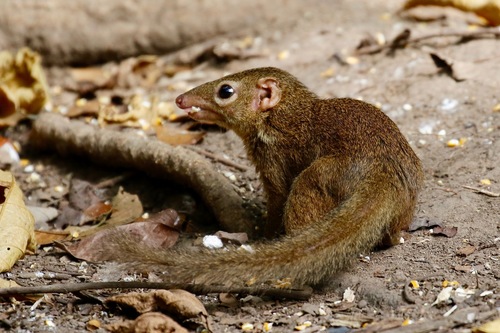
Northern Treeshrew
Tupaia belangeri
Meet the energetic Northern Treeshrew, a fast-moving Southeast Asian mammal that bridges the gap between early insectivores and primates. With its long snout and squirrel-like charm, it’s a master of the forest floor and a frequent visitor to tropical gardens.
Quick Identification
Size
Head-body length 16–23 cm (6–9 in); tail 15–20 cm (6–8 in); weight 100–220 g (3.5–7.8 oz)
Colors
Grizzled olive-brown to reddish-brown upperparts; pale creamy-yellow underparts; a faint, light-colored stripe is often visible on the shoulder.
Key Features
- Elongated, pointed snout with prominent whiskers
- Long, bushy tail resembling a squirrel's tail
- Large, dark eyes positioned laterally for wide-angle vision
- Small, human-like ears with complex cartilaginous ridges
When You’ll See Them
Geographic range
Where Does the Northern Treeshrew Live?
The Northern Treeshrew is a common sight across the diverse landscapes of Southeast Asia. Its native range begins in the eastern Himalayas of Northeast India and Bangladesh, extending eastward through Myanmar, Thailand, Laos, Cambodia, and Vietnam. It is also found across southern China, including Hainan island, thriving in both lowland plains and mid-elevation montane regions where cover is plentiful.
Basemap © OpenStreetMap contributors
Behavior
The Northern Treeshrew is a high-energy, diurnal mammal that spends its day in a state of constant motion. Despite their name and squirrel-like appearance, they spend a significant amount of time on the forest floor, scampering through leaf litter in search of food. They are remarkably agile climbers, using their sharp claws to navigate tree trunks, but they lack the specialized 'ankle-turning' ability of true squirrels, which makes their downward climbs slightly less fluid.
These animals are known for their unique social and reproductive behaviors. They typically live in monogamous pairs that defend a specific territory using scent markings from glands on their chest and abdomen. Perhaps their most famous trait is their 'absentee' parental care; a mother will nest her young in a separate location and visit them only once every 48 hours to provide a high-fat milk feeding that lasts just a few minutes, leaving the pups alone and silent the rest of the time to avoid attracting predators.
EverydayEarth exclusive
Camera Tips
Capturing a Northern Treeshrew on a trail camera requires a strategy focused on their ground-level foraging habits. These animals are 'scansorial,' meaning they are comfortable both in trees and on the ground. For the best results, place your camera just 20 to 30 centimeters (8 to 12 inches) above the ground. Direct the lens toward a clear area of the forest floor, particularly near fallen logs or at the base of large trees, which they frequently use as runways for travel.
To stop these fast-moving mammals long enough for a clear photo, use a scent or food lure. A small amount of honey or fruit jam smeared onto a log, or a few slices of very ripe banana, can be irresistible. Because they are incredibly twitchy and move with rapid, jerky motions, set your camera to 'Burst Mode' or 'Photo + Video.' A fast trigger speed of 0.3 seconds or less is highly recommended, otherwise, you may only capture a blurry tail as they zip past the sensor.
Timing is everything with this species. They are strictly diurnal, so ensure your camera is not set to power down during the day. They have two main activity peaks: one shortly after sunrise and another in the late afternoon before dusk. In backyard settings, look for 'edges'—the places where your garden meets denser brush or forest—as they prefer to stay close to cover while venturing out to forage.
Similar Species
Species that look similar or are commonly confused with Northern Treeshrew.
Common Treeshrew
Very similar, but the Common Treeshrew is generally found further south in the Malay Peninsula and Sumatra, and lacks the Northern species' specific grizzled fur pattern.
Pallas's Squirrel
Has a shorter, blunter snout and more rounded ears; typically spends more time in the high canopy compared to the treeshrew.
Frequently Asked Questions
Record Northern Treeshrew at your habitat
Connect a camera to start building your own species record — AI identifies every visitor automatically.