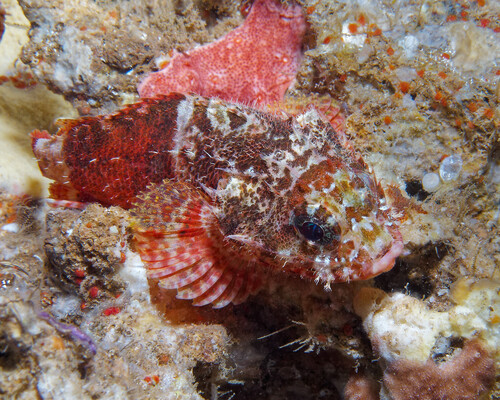
Coral Scorpionfish
Scorpaenodes parvipinnis
A pint-sized predator with a penchant for disguise, the Coral Scorpionfish is one of the reef's most elusive residents. This master of camouflage uses its mottled skin to vanish into the coral, waiting for the cover of night to strike.
Quick Identification
Size
Up to 10–13 cm (4–5 inches) in length; weight typically under 150 grams
Colors
Mottled red, pink, and white patterns with irregular dark blotches and spots; lacks distinct stripes but provides excellent coral-like camouflage
Key Features
- Small size for a scorpionfish
- Venomous dorsal and anal spines
- Short dorsal spines compared to other Scorpaenodes
- Cryptic, bumpy skin texture for camouflage
When You’ll See Them
Geographic range
Where Does the Coral Scorpionfish Live?
The Coral Scorpionfish is native to the vast tropical and subtropical waters of the Indo-Pacific region. Its range extends from the eastern coast of Africa and the Red Sea across the Indian Ocean to the central Pacific, reaching as far as Hawaii, the Line Islands, and the Tuamotu Archipelago. It is commonly found in the reef systems of northern Australia, the Japanese archipelago, and throughout the diverse marine habitats of Indonesia and the Philippines.
Basemap © OpenStreetMap contributors
Behavior
The Coral Scorpionfish is a master of stealth and a dedicated ambush predator. By day, it is extremely reclusive, tucking its small body into deep crevices, under coral ledges, or within the labyrinthine branches of reef structures to avoid larger predators. Because of its exceptional camouflage, it is rarely seen by casual observers unless it is disturbed or spotted by a keen eye during a night dive.
When darkness falls, this species becomes more active, though it still moves very little. It relies on a 'sit-and-wait' hunting strategy, remaining perfectly motionless until prey comes within striking distance. Interactions with humans are generally passive, though the fish possesses venomous spines for defense; stings typically occur only when a person accidentally touches the fish while reaching into a reef crevice.
EverydayEarth exclusive
Camera Tips
Capturing the Coral Scorpionfish on camera requires specialized underwater equipment and a focus on nighttime recording. Since these fish are small and remain stationary for long periods, high-resolution macro settings are essential. Use an underwater housing for your trail camera and mount it on a weighted tripod or a secure rock base near a known coral head or crevice entrance. Because they are nocturnal, you will need a reliable external light source; use red-filtered light if possible, as it is less likely to disturb the fish or its prey than harsh white light.
Motion detection can be tricky with scorpionfish because they move so infrequently. If your camera supports time-lapse mode, set it to trigger every 30 to 60 seconds during the night. This increases the chances of catching a 'strike' when the fish lunges at prey. If using motion sensors, ensure the sensitivity is set to the highest level, as the only movement might be the quick opening of the mouth or a slight shift in position.
Position your camera close to the substrate, aiming horizontally across the reef floor rather than straight down. This angle helps the fish's profile stand out against the background, making its cryptic features easier to identify. Look for 'rubble' zones or the edges of live coral colonies where small shrimp congregate, as these are the prime hunting grounds for the Coral Scorpionfish.
Similar Species
Species that look similar or are commonly confused with Coral Scorpionfish.
Guam Scorpionfish
Slightly larger with a more pronounced dark spot on the operculum (gill cover).
Leaf Scorpionfish
Features a much taller, sail-like dorsal fin and a more compressed, thin body shape.
Reef Stonefish
Significantly larger and bulkier with a more upturned mouth and skin that looks like rough stone rather than coral.
Frequently Asked Questions
Record Coral Scorpionfish at your habitat
Connect a camera to start building your own species record — AI identifies every visitor automatically.