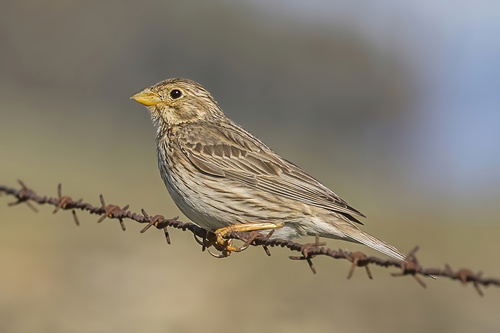
Corn Bunting
Emberiza calandra
The quintessential bird of the open fields, the Corn Bunting is famous for its 'jangling keys' song and its mastery of camouflage. While it may lack bright colors, its chunky silhouette and charming personality make it a favorite for those tracking the health of our rural landscapes.
Quick Identification
Size
Length: 16–19 cm (6.3–7.5 in); Wingspan: 26–32 cm (10–12.6 in); Weight: 35–65 g (1.2–2.3 oz)
Colors
Heavily streaked buff-brown plumage across the entire body; underside is paler with dark streaks; lacks the white outer tail feathers common in other buntings. Sexes are monochromatic, though males are noticeably larger.
Key Features
- Large, chunky build with a thick, yellowish finch-like bill
- Uniformly streaky brown appearance without bright colors
- Lacks white outer tail feathers in flight
- Distinctive 'jangling keys' song delivered from high perches
When You’ll See Them
Geographic range
Where Does the Corn Bunting Live?
Native to the Palearctic region, the Corn Bunting inhabits a vast territory spanning from Western Europe and North Africa through the Middle East to northwestern China. It is most densely concentrated in the Mediterranean basin and the agricultural plains of Central Europe, including countries like Spain, France, Turkey, and Bulgaria. While largely a resident species in the south, northern populations may move slightly to avoid harsh winter snow cover that hides their seed-based food sources.
Basemap © OpenStreetMap contributors
Behavior
The Corn Bunting is often affectionately known as the 'fat bird of the barley' due to its portly appearance and affinity for cereal crops. Unlike many of its colorful bunting relatives, this species relies on camouflage, blending perfectly into the dry grasses and plowed earth of its farmland habitat. During the breeding season, males are conspicuous as they sing from prominent lookouts such as fence posts, telephone wires, or the tops of bushes, often dangling their legs during short, fluttering display flights.
These birds are somewhat unusual among passerines for their polygynous mating system, where one male may defend a territory containing several nesting females. Outside of the breeding season, they become much more social, forming large communal roosts and foraging in mixed flocks with finches and sparrows. Their interaction with humans is almost entirely tied to agriculture; they thrive in traditional low-intensity farming landscapes but have suffered significant declines in areas with modern, intensive monoculture practices.
EverydayEarth exclusive
Camera Tips
To capture the Corn Bunting on a backyard or trail camera, focus on the edges of open spaces. If your property borders farmland or a large meadow, place your camera on a fence post or a dedicated stake about 3 to 5 feet off the ground. Because these birds love 'lookout' spots, a camera angled toward a solitary branch or a wire line will often catch the male performing his iconic song. Use a fast shutter speed to capture the vibrating throat feathers during their vocalizations.
For ground-based shots, create a feeding station using a mix of larger seeds like cracked corn, barley, and wheat. Unlike smaller finches, Corn Buntings prefer feeding on the ground rather than on hanging feeders. Place your camera 2 to 3 feet away from the bait site, angled slightly downward. Using a wide-angle lens is beneficial here, as these birds are often wary and prefer having a clear view of their surroundings while eating.
Timing is critical for this species. They are most active in the early morning light, which also provides the best golden-hour illumination for their subtle brown plumage. In the winter, you can attract larger groups by clearing a small patch of snow and depositing a heavy amount of grain; this is often the best time to see them in 'flocks' rather than as solitary territorial males. Ensure your camera is set to take 3-5 photo bursts or 15-second videos to catch their unique leg-dangling flight behavior.
Similar Species
Species that look similar or are commonly confused with Corn Bunting.
Frequently Asked Questions
Record Corn Bunting at your habitat
Connect a camera to start building your own species record — AI identifies every visitor automatically.