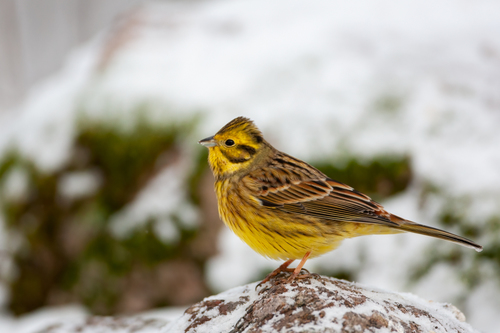
Yellowhammer
Emberiza citrinella
A splash of gold in the hedgerow, the Yellowhammer is a beloved icon of the Eurasian countryside. With its signature 'bread and no cheese' song and striking lemon-yellow feathers, it’s a rewarding visitor for any patient backyard observer.
Quick Identification
Size
Length: 16–16.5 cm (6.3–6.5 in), Wingspan: 23–29 cm (9–11.4 in), Weight: 20–36 g (0.7–1.3 oz)
Colors
Males feature a brilliant lemon-yellow head and underparts with a streaked brown back and a distinctive chestnut rump. Females and juveniles are much duller and more heavily streaked with brown.
Key Features
- Bright yellow head and underparts in breeding males
- Distinctive chestnut-brown rump visible in flight
- Thick, grey seed-eater's bill
- Longish tail with white outer feathers
When You’ll See Them
Behavior
Yellowhammers are quintessentially birds of the open countryside, often seen perched atop a hedgerow or a lone bush delivering their famous 'a little bit of bread and no cheese' song. While they are somewhat shy around human activity, they are highly social with their own kind, especially during the colder months. In winter, they frequently gather in small, loose flocks, often joining forces with other buntings and finches to forage in stubble fields and farmyards.
Their movement is characterized by a hopping gait on the ground and a distinctive undulating flight pattern. When startled, they tend to fly up into the nearest thicket or hedge for cover. During the breeding season, males become very territorial and conspicuous, using high vantage points to display their vibrant plumage and sing to attract mates, while females remain more elusive, tending to nests hidden low in dense vegetation or on the ground.
EverydayEarth exclusive
Camera Tips
To successfully capture a Yellowhammer on your backyard camera, placement is everything. These birds are ground-feeders by nature but very rarely venture far into the middle of a wide-open lawn. Position your camera about 6 to 12 inches off the ground, pointing toward the edge of a hedgerow, a brush pile, or a wild corner of your garden. Use a wide-angle lens setting if available, as they like to hop around while foraging. If you have a fence post or a tall, isolated shrub that they use as a 'song post,' mounting a second camera at eye level (4-5 feet) can capture stunning profile shots during the spring.
Baiting is highly effective for Yellowhammers, especially in winter when natural food is scarce. Instead of using a hanging feeder, which they rarely use, create a 'ground station.' Scatter a mix of fine seeds, crushed oats, millet, and sunflower hearts directly on the soil or a flat stone. Ensure the area is clear of tall grass so the camera's motion sensor isn't tripped by wind-blown blades, but keep the site within a few feet of cover so the birds feel safe enough to linger for the shot.
Lighting plays a massive role in showing off their namesake color. The yellow feathers of the male can easily 'blow out' and look like a white blur in harsh midday sun. Aim your camera North or South to avoid direct lens flare, and try to capture them during the 'golden hours' after sunrise or before sunset. This softer light saturates the yellow and brings out the intricate brown streaking on their backs. If your camera allows for shutter speed adjustments, keep it high (at least 1/500s) to freeze their quick, jerky head movements while they peck at seeds.
Similar Species
Species that look similar or are commonly confused with Yellowhammer.
Cirl Bunting
The Cirl Bunting has a black throat and a dark eye-stripe, whereas the Yellowhammer's face is much more extensively yellow.
Pine Bunting
Pine Bunting males have white on the head where the Yellowhammer has yellow; the two species are closely related and occasionally hybridize.
European Serin
The Serin is much smaller with a shorter, stumpier bill and lacks the chestnut-colored rump of the Yellowhammer.
Frequently Asked Questions
Record Yellowhammer at your habitat
Connect a camera to start building your own species record — AI identifies every visitor automatically.