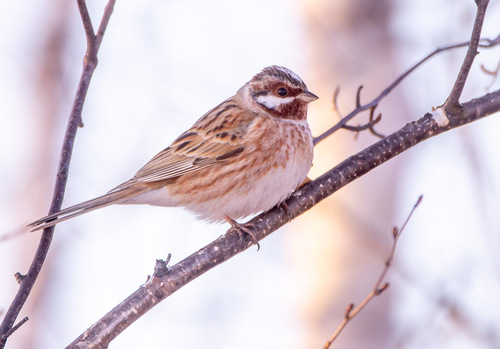
Pine Bunting
Emberiza leucocephalos
A striking traveler from the Siberian wilderness, the Pine Bunting brings a touch of the taiga to winter gardens. With its snowy-white crown and rich chestnut mask, it is one of the most handsome visitors a backyard observer can hope to spot.
Quick Identification
Size
Length: 16–17.5 cm (6.3–6.9 in); Wingspan: 26–30 cm (10–11.8 in); Weight: 21–37 g (0.7–1.3 oz)
Colors
Males have a distinctive white crown and cheek patches bordered by deep chestnut; females are drabber with grey-brown streaking and buff-white underparts.
Key Features
- Bright white crown and cheek patches (males)
- Deep chestnut-red throat and eyebrow (males)
- Streaked grey-brown back and mantle
- White outer tail feathers prominent in flight
- Stout, conical seed-cracking beak
When You’ll See Them
Behavior
The Pine Bunting is a hardy passerine known for its resilience in the cold climates of Eurasia. During the breeding season, they are somewhat territorial, with males choosing high perches—often the tops of pine trees—to sing their simple, tinkling songs. They are primarily ground-foragers, hopping through the undergrowth or across open soil in search of food. In the winter months, their social structure shifts significantly; they become quite gregarious, often forming large mixed-species flocks with other buntings and finches to forage in agricultural fields and rural gardens.
While they are generally shy around humans, they can become habituated to backyard settings if a reliable food source is present. They exhibit a characteristic 'pump' of the tail when perched and are known for their strong, undulating flight pattern. In areas where their range overlaps with the Yellowhammer, they are known to hybridize, leading to interesting intermediate plumage patterns that can challenge even experienced birders.
EverydayEarth exclusive
Camera Tips
To capture the Pine Bunting on camera, your best bet is to focus on ground-level activity. Since these birds are natural ground-feeders, placing your AI-powered camera 6 to 12 inches off the ground near a brush pile or thicket will provide the best results. They prefer to stay close to cover, so position your feeder or 'bait' area within a few feet of dense shrubs where they can quickly retreat if they feel threatened. A low-angle shot not only captures their intricate plumage details but also provides a more intimate, professional perspective of their foraging behavior.
In terms of bait, a high-quality wild bird mix containing millet, canary seed, and crushed sunflower hearts is irresistible to Pine Buntings during the colder months. If you are in a region where they visit during migration, providing a shallow ground-level birdbath can also be a significant draw. They are particularly active in the early morning light, so ensure your camera is positioned to avoid direct lens flare while still benefiting from the 'golden hour' illumination that will make the male's chestnut markings pop.
Because buntings are quick and can be twitchy when feeding, set your camera to a high trigger speed or 'burst mode' if available. A PIR (Passive Infrared) sensor sensitivity set to 'High' is recommended to catch these small, fast-moving targets. If you are using a trail camera with adjustable video lengths, short 10-15 second clips are ideal for capturing their social interactions without draining your battery too quickly. During mid-winter, consider placing the camera near a cleared patch of earth where the snow has been removed, as these birds will flock to any accessible ground to find fallen seeds.
Similar Species
Species that look similar or are commonly confused with Pine Bunting.
Frequently Asked Questions
Record Pine Bunting at your habitat
Connect a camera to start building your own species record — AI identifies every visitor automatically.