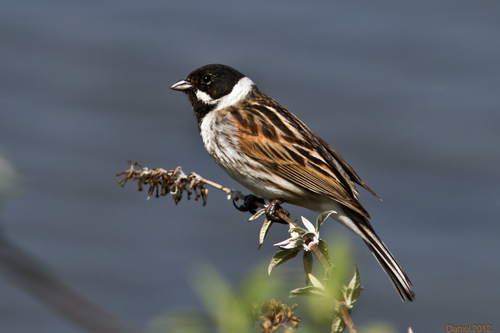
Reed Bunting
Emberiza schoeniclus
A resilient visitor from the wetlands, the Reed Bunting brings a touch of wild marshland to the suburban garden. Watch for the male's striking black hood in spring or the subtle, streaky charm of the winter visitors at your feeder.
Quick Identification
Size
Length: 15-16 cm (6 in); Wingspan: 21-28 cm (8.3-11 in); Weight: 17-25 g (0.6-0.9 oz)
Colors
Males in breeding plumage have a velvet-black head and throat contrasted by a bright white collar. Females and winter males are more cryptic, featuring streaky brown backs, buff underparts, and a pale stripe above the eye.
Key Features
- Male has a distinct black 'hood' and white collar in spring
- White outer tail feathers flash during flight
- Streaky brown plumage similar to a sparrow but with a more slender build
- Relatively heavy, dark seed-eating bill
When You’ll See Them
Behavior
Reed Buntings are hardy songbirds known for their adaptability. During the breeding season, they are specialists of the wetlands, where males can be seen singing their simple, rhythmic 'zrit-zrit-zrit-chissick' song from the tops of reeds or willow bushes. They are somewhat shy but become significantly more social during the winter months when they form mixed flocks with other buntings and finches to roam the countryside in search of food.
In a backyard setting, they exhibit a characteristic 'tail-flicking' behavior, repeatedly spreading their tail feathers to reveal flashes of white. While they are primarily ground feeders, they have learned to adapt to garden life, often visiting bird tables when natural seed sources in the marshes run low. Unlike the aggressive House Sparrow, Reed Buntings tend to be more cautious, often waiting on the periphery of a feeding station before moving in to eat.
EverydayEarth exclusive
Camera Tips
To capture the best footage of a Reed Bunting, you need to focus on ground-level activity. These birds rarely use hanging tube feeders; instead, they prefer to forage on the floor or on low, flat platforms. Position your camera on a short tripod or a ground mount, roughly 12 to 18 inches off the floor. Aim the lens at a cleared patch of ground or a low feeding tray placed near the edge of a hedge or shrubbery. The proximity to cover is essential, as Reed Buntings are nervous in open spaces and will appreciate a quick escape route into the bushes.
The ideal bait for attracting this species is a high-quality 'fines' mix or straight white millet. They have smaller bills than some other buntings and prefer tiny, easy-to-crack seeds. If you are using a trail camera, set it to 'Photo + Video' mode with a fast trigger speed. Reed Buntings are twitchy and fast-moving; a slow trigger will often result in a shot of a disappearing tail. If your camera allows for adjustable frame rates, choose 60fps to smoothly capture their signature tail-flicking motion.
Lighting is your best friend when trying to distinguish a non-breeding male or a female from a common sparrow. Try to position your camera facing away from the sun (North-facing is often best in the Northern Hemisphere) to prevent silhouetting. The soft light of early morning or late afternoon will highlight the subtle rufous tones in their wings and the pale 'eyebrow' stripe that is a key ID feature. If you have a water feature like a shallow ground-level birdbath, point a camera there; Reed Buntings are frequent bathers and offer great action shots when splashing.
Winter is the prime time for 'everyday' backyard captures. When the ground freezes in the marshlands, these birds head for suburban areas. During these cold snaps, increase your camera's sensitivity and ensure you have fresh batteries, as the increased traffic at your feeding station will trigger the camera more frequently. Look for them particularly after a light snowfall, as their brown plumage pops beautifully against a white background, making for 'hero' quality photographs.
Similar Species
Species that look similar or are commonly confused with Reed Bunting.
House Sparrow
Sparrows have a much chunkier build, thicker necks, and lack the white outer tail feathers of the Reed Bunting.
Corn Bunting
Larger and much paler/greyer, the Corn Bunting lacks the distinctive facial markings and white tail edges.
Yellowhammer
Similar in shape, but even the dullest female Yellowhammer usually shows some yellow on the head or underparts.
Frequently Asked Questions
Record Reed Bunting at your habitat
Connect a camera to start building your own species record — AI identifies every visitor automatically.