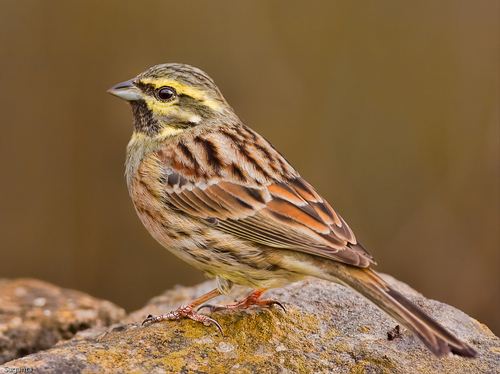
Cirl Bunting
Emberiza cirlus
A hidden treasure of the Mediterranean and the Devon coast, the Cirl Bunting is a master of the hedgerow. With its striking black-and-yellow mask and a song that signals the heat of summer, this resilient bird is a favorite for those who know where to look.
Quick Identification
Size
Length: 15–16.5 cm (6 in); Wingspan: 22–25.5 cm (8.5–10 in); Weight: 20–25 g (0.7–0.9 oz)
Colors
Males have a black throat, black eye-stripe, yellow head stripes, and an olive-green breast band. Females are streaky brown with a distinctive olive-grey rump.
Key Features
- Bold black throat and eye-stripe on males
- Olive-green band across the upper breast
- Dull olive-grey rump (distinguishes from Yellowhammer)
- Yellow underparts with subtle flank streaking
- Thick, grey seed-cracking bill
When You’ll See Them
Geographic range
Where Does the Cirl Bunting Live?
Native to the warmer regions of Europe and North Africa, the Cirl Bunting is most at home across the Mediterranean basin, from Portugal and Spain through France to Italy and Greece. It maintains a famous northern outpost in Southwest England, specifically within the county of Devon, where dedicated conservation efforts have brought the population back from the brink. It is a resident species throughout its range, rarely wandering far from its preferred warm, low-lying coastal and agricultural landscapes.
Basemap © OpenStreetMap contributors
Behavior
Cirl Buntings are notoriously shy and retiring birds, often preferring the safety of dense hedgerows to open ground. Unlike many other buntings, they are largely sedentary, rarely moving more than a few kilometers from their birthplace. They spend much of their time foraging on the ground, moving with a quiet, hopping gait as they search for fallen seeds or insects.
During the breeding season, males become more conspicuous, choosing high, exposed song-posts—often the top of a tall hedge or a telegraph pole—to deliver their rapid, rattling trill. While they are solitary nesters, they may form small, loose-knit flocks during the winter months, occasionally mingling with other finches and buntings to exploit rich food sources like winter stubble fields or bird tables in quiet gardens.
EverydayEarth exclusive
Camera Tips
To capture the elusive Cirl Bunting on camera, focus on the 'transition zones' of your garden or property. These birds are edge-dwellers that rarely venture far from dense cover. Position your camera about 0.5 to 1 meter (1.5–3 feet) off the ground, aiming it toward a patch of bare earth or short grass located within two meters of a thick hedge or evergreen shrub. This provides the birds with the security they need to land and forage.
Baiting is highly effective for this species, especially in the colder months. Rather than using hanging feeders, which they often avoid, scatter a 'Cirl Bunting mix' of small seeds like red millet, canary seed, and crushed sunflower hearts directly on the ground. To keep the birds in the frame longer, place the seeds in a small, shallow depression or among some flat stones. In the summer, providing a shallow ground-level birdbath can also be a significant draw, as they need to drink and bathe frequently in their dry, sunny habitats.
Set your camera to a high trigger sensitivity and use the video mode with a 10-20 second duration. Cirl Buntings move with quick, jerky motions that can sometimes fail to trigger slower sensors. If your camera allows for it, use a 'burst' photo mode of 3-5 frames to ensure you catch the male's striking facial markings. Because they are most active in the early morning, ensure your camera is positioned to avoid direct sunrise glare, which can wash out the subtle olive tones of their plumage.
Similar Species
Species that look similar or are commonly confused with Cirl Bunting.
Yellowhammer
Yellowhammers have a bright chestnut rump and a much yellower head without the Cirl Bunting's black throat and eye-stripe.
Reed Bunting
Male Reed Buntings have a solid black head and a white collar, and they prefer much wetter, marshy habitats.
Corn Bunting
The Corn Bunting is larger, bulkier, and has a very plain, streaky brown appearance without any of the Cirl Bunting's yellow or black markings.
Frequently Asked Questions
Record Cirl Bunting at your habitat
Connect a camera to start building your own species record — AI identifies every visitor automatically.