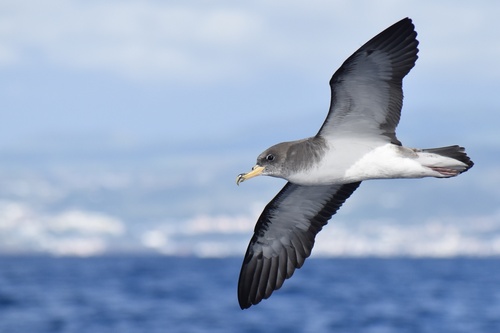
Cory's Shearwater
Calonectris borealis
The ghost of the Atlantic waves, Cory’s Shearwater is a master glider that travels thousands of miles across the open ocean before returning to rocky island cliffs under the cover of night.
Quick Identification
Size
Length: 45–56 cm (18–22 in); Wingspan: 112–126 cm (44–50 in); Weight: 700–1,100 g (1.5–2.4 lbs)
Colors
Brownish-gray upperparts; pure white underparts; thick, yellowish bill with a dark smudge near the tip; pinkish-flesh legs.
Key Features
- Large, stocky seabird with long, broad wings
- Thick, dull yellow bill with a dark subterminal band
- Characteristic 'shearing' flight with slow, deep wingbeats
- White underwings with a narrow, dark trailing edge
When You’ll See Them
Geographic range
Where Does the Cory's Shearwater Live?
Native to the Eastern Atlantic, Cory's Shearwater is most commonly found breeding on the archipelagos of the Azores, Madeira, and the Canary Islands. During the northern summer, it is a frequent visitor to the western Atlantic, appearing in significant numbers off the coast of the United States and Canada. This highly migratory species travels across the equator to spend the winter months in the South Atlantic, ranging from the coast of Brazil to the waters surrounding South Africa.
Basemap © OpenStreetMap contributors
Behavior
Cory’s Shearwaters are supreme marathoners of the avian world, spending nearly their entire lives on the open ocean. They are best known for their 'shearing' flight, a graceful technique where they tilt from side to side, skimming the water's surface with one wingtip almost touching the waves. This allows them to use the wind gradients above the swells to glide for miles with very little effort. While they are quiet at sea, they become incredibly vocal at their breeding colonies, emitting haunting, rhythmic wails that can be heard from a distance after dark.
These birds are colonial nesters, returning to the same rocky crevices or burrows on Atlantic islands year after year. To protect themselves from predatory gulls, they are strictly nocturnal on land, only arriving at or departing from their nests under the cover of night. At sea, they are social foragers, often seen in large 'rafts' resting on the water or following fishing boats in hopes of a free meal. They have a fascinating relationship with underwater predators like tuna and dolphins, often hovering above them to catch small fish forced to the surface by the larger hunters.
EverydayEarth exclusive
Camera Tips
Capturing a Cory's Shearwater on camera is a unique challenge because they are almost never found in traditional inland backyards. However, if you live in a coastal area or on an Atlantic island near a colony, your best bet is a trail camera with high-quality Infrared (IR) night vision. Because these birds only visit land at night to avoid predators, standard daytime photography won't capture their terrestrial behavior. Place your camera near known burrow entrances or rocky crevices on cliffsides, angling it slightly upward to capture them as they land or depart.
Since shearwaters are fast and move erratically when landing, set your camera to 'Burst Mode' or high-speed video. A trigger speed of 0.2 seconds or faster is essential to catch them before they disappear into their burrows. Avoid using white light flashes, as this can disorient the birds and make them vulnerable to predators; stick exclusively to 'No-Glow' or 'Black' IR LEDs to keep the environment natural and undisturbed.
If you are monitoring from a seaside balcony or cliff edge during the day, use a camera with a telephoto lens or a high-resolution sensor that allows for cropping. Set the shutter speed to at least 1/2000th of a second to freeze their fast-moving 'shearing' flight over the waves. The best time to see them near shore is during 'onshore' winds, which push the birds closer to the coast, particularly in the late afternoon as they begin to gather before heading to their nests.
Similar Species
Species that look similar or are commonly confused with Cory's Shearwater.
Scopoli's Shearwater
Smaller and slimmer than Cory's, with more extensive white 'fingers' projecting into the dark wingtips.
Great Shearwater
Features a distinct dark cap, a white collar, and a much darker, thinner bill than the yellowish bill of the Cory's.
Northern Fulmar
Stubby-winged with a shorter, thicker 'tubeneose' bill and a much more gull-like appearance.
Frequently Asked Questions
Record Cory's Shearwater at your habitat
Connect a camera to start building your own species record — AI identifies every visitor automatically.