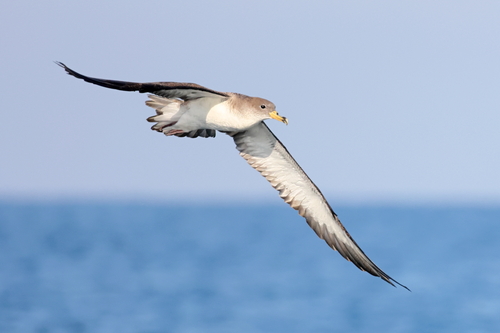
Scopoli's Shearwater
Calonectris diomedea
A ghostly wanderer of the Mediterranean, the Scopoli's Shearwater combines effortless aerial grace with a mysterious nocturnal life. Watch as they transform from silent ocean gliders to vocal cliff-dwellers under the stars.
Quick Identification
Size
Length: 45–52 cm (18–20 in); Wingspan: 112–122 cm (44–48 in); Weight: 350–600 g (0.77–1.32 lbs)
Colors
Brownish-grey upperparts with darker flight feathers; pure white underparts. The bill is a distinctive pale yellow with a dark greyish-black patch near the tip.
Key Features
- Pale yellow bill with dark tip
- Large wingspan with 'shearing' flight pattern
- Brownish-grey upperparts without a distinct 'M' pattern
- White underwings with thin dark borders
When You’ll See Them
Behavior
Scopoli's Shearwaters are masters of the pelagic environment, spending the vast majority of their lives far out at sea. They are famous for their dynamic soaring technique, known as 'shearing,' where they use the wind gradients above waves to glide for miles with minimal effort. While they are silent and solitary hunters on the open ocean, they become highly social during the breeding season, forming massive 'rafts' of thousands of birds on the water surface near their nesting colonies.
When returning to land, they are strictly nocturnal to avoid predation by gulls and hawks. Their behavior at the colony is a stark contrast to their graceful flight; on land, they are clumsy and vocal, emitting eerie, rhythmic wailing calls that sound almost like a crying child. They are long-lived birds that often return to the same rocky crevice or burrow year after year to raise a single chick with their lifelong mate.
EverydayEarth exclusive
Camera Tips
Capturing the Scopoli's Shearwater on camera is a unique challenge because they are almost never found in traditional suburban backyards. To see them, you'll need to place your AI-powered camera on coastal properties overlooking the Mediterranean or Atlantic, or near known nesting colonies on rocky islands. Because they only visit land under the cover of darkness, your camera's infrared (IR) performance is the most critical factor. Look for a camera with 'No-Glow' IR LEDs to ensure the birds aren't spooked as they land near their burrows.
Position your camera low to the ground, roughly 12-18 inches high, aimed at the entrance of rocky crevices or burrows. Since these birds are surprisingly large when they land, give the camera enough back-distance (3-5 feet) to ensure the entire bird stays in the frame. If you are setting up on a cliffside, ensure the camera is securely tethered, as these environments are prone to high winds and salt spray which can shift or damage unsecured equipment.
A unique strategy for capturing 'action' shots is to place the camera near a prominent 'taking off' rock—a high point near the colony where birds waddle to gain enough height to catch the wind. Set your AI trigger to high sensitivity and use a fast shutter speed setting if available, as their departure can be sudden. Avoid using white-light flashes, as this can disorient the birds and make them vulnerable to predators.
Maintenance is key in marine environments. Salt crust will build up on your lens and PIR sensor quickly, leading to blurry images or missed triggers. We recommend wiping the lens with a fresh-water dampened cloth once a week. If your camera supports video, enable it; the haunting vocalizations of the Scopoli's Shearwater are just as iconic as their appearance and provide an incredible layer of data to your wildlife observations.
Similar Species
Species that look similar or are commonly confused with Scopoli's Shearwater.
Cory's Shearwater
Larger body size and more dark coloring on the underside of the wing tips.
Yelkouan Shearwater
Much smaller with a darker, more contrasting upper/lower color split and faster wingbeats.
Manx Shearwater
Smaller with a blacker back and shorter wings, primarily found in the North Atlantic.
Frequently Asked Questions
Record Scopoli's Shearwater at your habitat
Connect a camera to start building your own species record — AI identifies every visitor automatically.