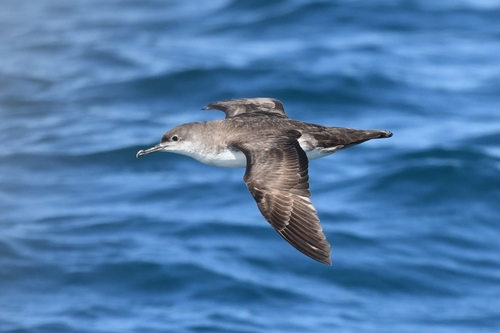
Yelkouan Shearwater
Puffinus yelkouan
The Yelkouan Shearwater is a hauntingly beautiful seabird that spends its life dancing over Mediterranean waves, returning to the shadows of coastal cliffs only under the veil of night.
Quick Identification
Size
Length: 30-38 cm (12-15 in); Wingspan: 76-89 cm (30-35 in); Weight: 330-480 g (11.6-17 oz)
Colors
Dark sooty-brown upperparts and crisp white underparts; dark bill; legs are pinkish but appear dark at a distance.
Key Features
- Contrast between dark brown back and white belly
- Slender, hooked dark bill
- Stiff-winged flight style with rapid beats and long glides
- Feet often protrude slightly beyond the short tail in flight
When You’ll See Them
Behavior
The Yelkouan Shearwater is a master of the air-water interface, named for its characteristic 'shearing' flight where it tilts from side to side, wingtips nearly touching the waves. Highly gregarious at sea, they are often seen in large groups known as 'rafts,' floating together while resting or waiting for schools of fish to surface. They are incredibly silent while at sea but become remarkably vocal at their nesting colonies, emitting eerie, rhythmic cackling calls that can be heard echoing off cliff faces.
Unlike many garden birds, this species only comes to land to breed. They are strictly nocturnal when visiting their nesting sites on land to avoid predation by gulls and rats. This creates a fascinating 'ghost' behavior where a cliffside may seem empty by day but teems with activity under the cover of darkness. They are sensitive to human disturbance, particularly light pollution, which can disorient young fledglings as they attempt to reach the sea for the first time.
EverydayEarth exclusive
Camera Tips
Capturing a Yelkouan Shearwater on a trail camera is a unique challenge because they are almost exclusively pelagic. If you live on a Mediterranean cliffside or near a known colony, placement is everything. Focus your camera on the entrances of rocky crevices or burrows on steep, vegetated slopes. Because these birds only visit land at night, a camera with high-quality 'no-glow' Infrared (IR) LEDs is mandatory. Standard white flashes will scare the birds and may lead to nest abandonment.
Set your camera to 'Hybrid Mode' if available, capturing both a high-resolution still and a short video clip (10-15 seconds). The video is essential for capturing their unique, clumsy terrestrial gait as they shuffle from the burrow to the cliff edge to take flight. Position the camera low to the ground, about 6-12 inches high, angled slightly upward toward the burrow entrance. Since they are fast-moving when they land, a camera with a trigger speed of 0.3 seconds or faster is highly recommended to avoid getting 'blank' shots of a bird that has already moved out of frame.
Avoid using any food lures or baits, as this can attract predators like rats or feral cats which are the primary threat to shearwater eggs and chicks. Instead, focus on natural funnels—narrow gaps between rocks or clear paths through coastal scrub that lead toward nesting holes. In terms of timing, the highest activity occurs during the prospecting phase in February and March, and again when feeding chicks in May and June. On moonless, cloudy nights, the birds are often bolder and more active on land, providing the best opportunities for clear footage.
Similar Species
Species that look similar or are commonly confused with Yelkouan Shearwater.
Manx Shearwater
Has deeper black upperparts and cleaner white underparts; its feet do not protrude past the tail in flight.
Balearic Shearwater
Generally bulkier with much durtier, brownish-grey underparts rather than the Yelkouan's crisp white belly.
Scopoli's Shearwater
Significantly larger with a heavy yellow bill and much slower, more effortless wingbeats.
Frequently Asked Questions
Record Yelkouan Shearwater at your habitat
Connect a camera to start building your own species record — AI identifies every visitor automatically.