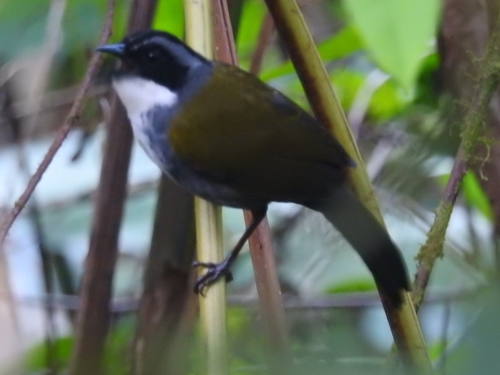
Costa Rican Brushfinch
Arremon costaricensis
A dapper resident of the Central American undergrowth, the Costa Rican Brushfinch is easily recognized by its striking 'mask' and bold chest band. This ground-dwelling specialist brings a touch of cloud-forest mystery to shaded backyard edges.
Quick Identification
Size
Length: 15–16 cm (5.9–6.3 in); Weight: 30–35 g (1.1–1.2 oz)
Colors
Bold black and white head stripes, white throat, olive-green back, and a distinct black chest band. Males and females are identical in appearance.
Key Features
- Prominent white stripe over the eye (supercilium)
- Solid black 'necklace' or pectoral band across the chest
- Olive-green wings and upperparts
- Sharp white median crown stripe
When You’ll See Them
Geographic range
Where Does the Costa Rican Brushfinch Live?
This bird is a regional specialty native to the southern Pacific slope of Central America. Its range is concentrated in the highlands of southern Costa Rica and extends into western Panama, specifically within the Chiriquí and Veraguas provinces. It is a non-migratory resident of these humid, mid-elevation environments, rarely wandering far from its birth territory.
Basemap © OpenStreetMap contributors
Behavior
The Costa Rican Brushfinch is a secretive and primarily terrestrial bird that spends its day hopping through the dense undergrowth. It is most frequently observed scratching through leaf litter in search of food, often in pairs or small family groups. Unlike more gregarious garden birds, this species is relatively shy and prefers to remain within the shadows of thick vegetation, making it a rewarding challenge for backyard observers to spot.
These birds are highly territorial and use a series of high-pitched chirps and complex songs to define their boundaries, especially during the early morning hours. While they are not known for long-distance flight, they are incredibly agile on the ground and through tangled vines. Their interaction with humans is minimal, as they tend to retreat into the brush at the first sign of movement, though they can become accustomed to quiet, consistent observers in shaded garden edges.
EverydayEarth exclusive
Camera Tips
To capture high-quality footage of the Costa Rican Brushfinch, you must focus on ground-level activity. Position your AI camera no more than 6 to 12 inches off the ground, ideally pointing toward a patch of natural leaf litter near the edge of dense shrubbery. These birds feel safest when they have a quick escape route into thick cover, so avoid placing cameras in the middle of open lawns. A slight upward tilt of the lens can help capture the bird's white throat and black chest band in more detail.
Attracting this species requires mimicking their natural foraging environment. Try creating a 'scratch zone' by clearing a small 2x2 foot area of grass and replacing it with mulch or dried leaves. Scatter a small amount of mealworms or finely cracked corn beneath the leaves. This will trigger their natural instinct to scratch and sift, keeping them in the camera's frame for several minutes at a time. Because they are shy, using a camera with a silent shutter is highly recommended.
Lighting is often a challenge in their preferred shaded habitats. If possible, set your camera in a spot that receives 'dappled' sunlight during the early morning hours. Since these birds move with quick, jerky hops, use a high shutter speed or a 'sports mode' setting on your camera to prevent motion blur. If your camera supports it, enable a pre-trigger or high-sensitivity PIR sensor setting to ensure you don't miss them as they dart in and out of the brush.
Similar Species
Species that look similar or are commonly confused with Costa Rican Brushfinch.
Black-striped Sparrow
Lacks the bold black chest band and has a more brownish-grey tone to its body compared to the brushfinch's olive back.
Sooty-faced Finch
Darker overall with a greyish face and lacks the bright white crown and eye stripes of the brushfinch.
White-naped Brushfinch
Found at higher elevations and features a yellow throat instead of the Costa Rican Brushfinch's white throat.
Frequently Asked Questions
Record Costa Rican Brushfinch at your habitat
Connect a camera to start building your own species record — AI identifies every visitor automatically.