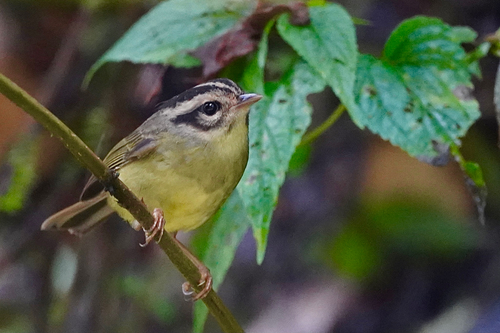
Costa Rican Warbler
Basileuterus melanotis
A restless gem of the Central American highlands, the Costa Rican Warbler is instantly recognizable by its bold black 'ears' and high-energy personality. This understory specialist is a favorite for those exploring the misty cloud forests of the Talamanca range.
Quick Identification
Size
Approximately 13 cm (5.1 in) in length; weight ranges from 12 to 15 grams.
Colors
Olive-green upperparts with a pale yellow to buffy belly. Notable for its bold black ear patches (auriculars) and a buff-white eyebrow stripe. It features a yellow or orange crown stripe that is often partially concealed.
Key Features
- Large, distinctive black ear patches
- Bold buffy-white supercilium (eyebrow)
- Dull olive-green back and wings
- Hyperactive wing-flicking behavior
When You’ll See Them
Geographic range
Where Does the Costa Rican Warbler Live?
The Costa Rican Warbler is a regional specialist native to the highlands of Central America. Its core range is concentrated within the Talamancan montane forests of Costa Rica and western Panama. Thriving in the cool, moist air of high-altitude corridors, this species is a permanent resident of these misty mountain peaks and is not found anywhere else in the world.
Basemap © OpenStreetMap contributors
Behavior
The Costa Rican Warbler is a high-energy inhabitant of the forest understory, characterized by its restless nature. It is almost constantly in motion, flitting through dense foliage or hopping along mossy logs and the leaf litter in search of prey. Unlike many wood-warblers that stay high in the canopy, this species is a specialist of the lower levels, rarely venturing more than a few meters off the ground.
These birds are typically found in pairs or small family groups and are known to be quite social, often participating in mixed-species foraging flocks. They communicate with sharp, metallic 'tsip' calls and are highly territorial. While they aren't especially shy around humans, their preference for the dark, tangled growth of cloud forests makes them easier to hear than to see.
EverydayEarth exclusive
Camera Tips
To successfully capture a Costa Rican Warbler on your AI camera, placement is everything. These birds are understory specialists, so mount your camera low—between knee and waist height—pointing toward a clearing in the leaf litter or a moss-covered fallen log. Because they love moisture, placing a camera near a small forest seep or a natural dripping rock face in a cloud forest environment will significantly increase your chances of a sighting.
These warblers are incredibly fast and known for their nervous wing-flicking, which can result in blurry images. Use a camera with a fast trigger speed and set it to take a burst of 3-5 photos per trigger. This increases the likelihood of getting one clear shot where the bird isn't mid-hop. If your camera settings allow for high ISO or 'fast' exposure times, use them, as the forest floor in their habitat is often quite dark due to the dense canopy and frequent mist.
In a backyard setting bordering a highland forest, you can attract them by maintaining a 'wild' area with deep mulch and native shrubs like Melastomes. They are not attracted to seed feeders, but a ground-level birdbath with a solar-powered dripper is a magnetic lure. The sound of moving water is often the best way to pull this species out of the thick brush and into your camera's field of view.
Similar Species
Species that look similar or are commonly confused with Costa Rican Warbler.
Three-striped Warbler
Found in South America; has much paler, less distinct ear patches compared to the Costa Rican species.
Golden-crowned Warbler
Smaller with a more vivid yellow crown and lacks the large, dark 'ear' patch characteristic of the Costa Rican Warbler.
Rufous-capped Warbler
Features a bright rufous crown and ear area with white 'spectacles' around the eyes, rather than black auriculars.
Frequently Asked Questions
Record Costa Rican Warbler at your habitat
Connect a camera to start building your own species record — AI identifies every visitor automatically.